28 May 2006

Why Defining Requirements is Not Good Enough

A recent comment on this blog (thanks James) stimulated me enough to put pen to paper and to explain why "defining requirements" is not enough.

Once upon a time, the mainframe was. The mainframe hosted complex corporate applications that required a very disciplined and sequential approach to requirements definition. In particular, it required requirements to be fully flushed out before coding began. Changing requirements en route was a big no-no and (mostly) constituted a too expensive proposition.

That era is gone, although it has been noted that some environments still exact the same sequential and disciplined approach to requirements definition, which dates back from mainframe times. The generally accepted approach in software development now calls for iterative (or evolutive) development. You figure out what you need, then you build some. By building some, you can better articulate further requirements. The cycle continues.

Similarly to the passage from sequential and disciplined requirements definition to evolutive requirements definition; I advocate to go from "specific capability evolutive requirements definition" to "integrated information management planning".

It is not good enough to adopt, as a starting point, "we need a content management system", or "we need a document and records management system". Other starting points are equally not valid: "we need a new records management policy", "we need a new training program". The optimum starting point should be: "we need a sound information architecture promoting integrated information management". Note: I actually believe that integrated information management nicely paves the way to ulterior knowledge management, but this is a contentious issue best left to be discussed at another time.

What of reality? How to achieve "the real thing" - a supportive and compliant information environment?

Here's the recipe. Many of these concepts (including Standard Information Management Frameworks) are fully explored in a new 3-day course offered at the Canada School of the Public Service:
  1. Just as architects need blueprints, general need battle maps and accountants need ledgers; information managers need a standard information management framework from which they can plan, design and develop the optimal information architecture for their Department - Agency - Company. The development of such a framework has been hampered by the lack of recognition of "information management" as a unified management discipline. I will explore these topics in a conference I'm giving at the ARMA Canadian Regional Conference in two days (sessions T31, T41).
  2. The Standard Information Management Framework answers the following questions: what are the necessary and sufficient components, in order to implement integrated information management? What is necessary to take into account, in order to develop each of these components? How can information management Vision and key Principles be tied to these components? And, last but not least, how can directives and end user guidance be derived from all of this?!
  3. The Standard Information Management Framework has nine components: information context, information requirements, information resources, information activities, information roles / services / products, information training / education / standards, Recorded Information (includes Data, Records and Library Management), Information Technology and Architecture Optimization. These nine components, when developed and applied to any particular environment, constitute an Information Management Architecture. You need all components. You do not need other components.
  4. Six areas of considerations need to be taken into consideration when developing the IM Architecture: Compliance (with legislation, regulations, policies, etc.), Business Context, User Empowerment, Interdependencies, Constraints and Trends & Opportunities. Each of these categories need to be populated with relevants "considerations", for example, in any given work environment, a complete inventory of applicable legislation related to information management, and then, for each such Statute, the information manager should analyze what is the impact of that legislation on any, many or all IM Architecture components.
  5. Vision and Principles need to be taken into consideration when developing the IM Architecture: Each organization, even within a large Department, is unique, and will warrant a distinct information management vision that should be tied to its role and mandate. Selected principles will vary over time; depending on where senior management wants to focus efforts. Examples of principles include Life-Cycle Approach, Accessibility, Security, Accountability, etc.
  6. The IM Architecture needs to be translated into IM Directives to realize the potential of integrated information management. Directives should be written from end end user point of view and help them do what they need to do, daily (here is a draft example in a particular environment).
One of the fundamental changes brought by this integrated approach has to do with requirements definition. The integrated approach considers six areas of inputs to develop nine IM architectural components. One of these components is Information Technology.

To compare the old and the new, one could say that whereas the old approach saw Compliance (sometimes), the Business Context and User Empowerment (ideally) taken into account to flush out the requirements of a subset of Information Technology (any given IT capability - e.g. Content Management System, etc.); the new approach formally adds Interdependencies, Constraints and Trends & Opportunities into the equation, not only to define "requirements" for a specific IT capability, but to architect the complete IM solution (which is larger than the total IT solution).

In that integrated analysis, one must let himself or herself be influenced by Trends & Opportunities. For example, the ways in which the marketplace is naturally shaping itself into "categories of software" is pertinent. For example, there is a category of solutions catering to documents and records management. Another catering to practice and case management (often in law firms). Another catering to generic web content management. If your "client" has a set of requirements that spans the entire spectrum covered by these three category of solutions; will you ignore these "marketplace facts", or will you structure your Request for Proposal accordingly, by articulating three distinct sets of requirements?

Just defining requirements is not good enough. One must get involved in becoming more knowledgeable in current trends & technologies; one must become more knowledgeable in how the marketplace confirms standard ways to manage information (e.g. wikis, blogs, syndication via RSS, etc.) and, most importantly; one must take a stand on deciding how to best marry a set of business requirements to a set of solutions. If information managers do not do this, who will?

Along that vein, I believe that when these "categories of software" are studied, you become familiar with the good and the not so good. Best features will become apparent. From these best or desirable features, you can build a list of criteria to iteratively assess solutions in a particular category. All of this work and analysis should be done in the spirit of integrated information management, not with any agenda of promoting a specific product.

Now here comes the tough part.

If you have done all the work previously explained, then you can make some judgment calls. And start figuring out your top picks in any given category of solutions. For example, after completion of this kind of analysis; if you come to the conclusion that you require a web content management system; and that the environment in which it needs to be deployed corresponds to features A - B - C being mandatory or desirable; and that such features are best implemented in a particular solution, do not be afraid to take the next step. Do not let the old disciplined and sequential requirements definition process hijack common sense hardly derived from an integrated approach analysis. Go forward. That may take some wrestling with proponents of the old approach, insisting that you stick to "requirements definition" and do not concern yourself with investigating solutions; go forward anyway. And hopefully, in the process, your colleagues will realize that you are doing something potentially novel: implementing a solution that works from all angles. Of course: that solution flows from an integrated approach analysis. ;-)

27 May 2006

Why Drupal Would Make Sense in the Government of Canada

Drupal, a free and open source web content management system, represents a very attrative option for managing content online. Here follows a list of reasons why I find it attractive in a federal government context:
  1. Drupal is free and open source software (FOSS). Treasury Board Secretariat guidelines prescribe Departments and Agencies to at least consider FOSS alternatives, especially when they are viable.
  2. Drupal is a stable, mature and robust WCMS, as confirmed from neutral sources in the book "Open Source for the Enterprise: Managing Risks - Reaping Rewards", see the book review.
  3. Drupal only requires PHP and MySQL on the server to run. PHP and MySQL are often authorized on governmental intranets and internet servers. This means that you can avoid a lengthy procurement process, it can be up and running in a few days - literally. I have myself deployed a Drupal site in a few hours - and I'm not a programmer.
  4. Drupal can power sites that are "Common Look & Feel" (CLF). All that is needed is to develop a drupal CLF Theme. This is something we are working on and we can share that Theme with you.
  5. Drupal can power sites that are fully multilingual, hence, bilingual - for interface and content. I was in Toronto last week and saw a demo of a live, fully developed trilingual drupal site (English, French and Spanish).
  6. Drupal can support multi-sites. That means that with one installation of drupal, you can maintain a lot (I do not know the limit) of totally different sites, even with different domain names. Very useful when it comes to upgrades and patches - only one installation to deal with and all sites are automatically updated.
  7. Drupal is fully Web 2.0 enabled, that is, aligned with major trends and technologies worldwide, and incorporates (if and only if these features are "turned on") blogs, free tagging (folksonomies), wikis, automatic syndication, forums, commenting, aggregation, etc...
  8. Drupal also supports traditional methods of organizing information, such as "categories" that can be assigned to content according to a centrally defined taxonomy. This can be done concurrently with free tagging, in which users decide which tags to add to contributed content.
  9. Drupal supports custom content types. For example, if you were to build a registry of applications in use in any given Department or Agency, "application" could be defined as a content type and you could further define what kind of information you want to track for each application. Because this is done within drupal, you would automatically benefit from all the other drupal features - the ability to (if you turn these features on) comment on applications, view them differently (sort - filter), etc.
  10. Drupal supports custom roles and permissions. You can define, for example, an "Administrator" role, "Project Lead" role, and as any roles as you need to differentiate between what some users can and cannot do. This is all done via a web interface.
  11. Drupal has a modular architecture. You only add / select / enable the modules you want / need.
If you are in the federal government, working in Ottawa and interested in Drupal, make sure that you signup with the Drupal Ottawa User Group.

[cross posted on G2TT]

Categories:

Bloggers Afforded Protection by US Court

In a recent decision, the Sixth District Court of Appeals (California) has afforded bloggers the same kind of protection usually reserved to journalists. Here is an extract from the judgment:
The trial court denied the motion on the ground that the publishers had involved themselves in the unlawful misappropriation of a trade secret. We hold that this was error because (1) the subpoena to the email service provider cannot be enforced consistent with the plain terms of the federal Stored Communications Act (18 U.S.C. §§ 2701-2712); (2) any subpoenas seeking unpublished information from petitioners would be unenforceable through contempt proceedings in light of the California reporter’s shield (Cal. Const., art. I, § 2, subd (b); Evid. Code, § 1070); and (3) discovery of petitioners’ sources is also barred on this record by the conditional constitutional privilege against compulsory disclosure of confidential sources (see Mitchell v. Superior Court (1984) 37 Cal.3d 268 (Mitchell)). Accordingly, we will issue a writ of mandate directing the trial court to grant the motion for a protective order.
The interesting part starts at p. 35 of the judgment, about "legitimate" journalism. The court states:
We decline the implicit invitation to embroil ourselves in questions of what constitutes “legitimate journalis[m].” The shield law is intended to protect the gathering and dissemination of news, and that is what petitioners did here. We can think of no workable test or principle that would distinguish “legitimate” from “illegitimate” news. Any attempt by courts to draw such a distinction would imperil a fundamental purpose of the First Amendment, which is to identify the best, most important, and most valuable ideas not by any sociological or economic formula, rule of law, or process of government, but through the rough and tumble competition of the memetic marketplace.
Thanks to Somewhat Frank for reporting this.

PS: for the careful reader... you will note that the court used Wikipedia as a reference, in footnote 16.

[cross-posted on slaw]

Categories:

20 May 2006

Government of Canada IM Day 2006 | Web 2.0 "Track"

Last week, the planning committee of the Fall 2006 Government of Canada "Information Management Day" (GC IM Day) met, and we flushed out some ideas on what topics to put on the schedule. In our current planning, one track will have the "Leading" flavour, in the sense of leading change, and that one or two sessions under that track will specifically deal with Web 2.0 implementations in the Government of Canada - existing, proposed and suggested.

IM Day is an event planned by Public Servants for Public Servants, held in Ottawa every Fall. It is very well attended by key individuals in information management throughout federal government. There are chances are that our keynote speaker (not selected yet) will be "web 2.0 enabled" this year...

Do you have an example of Drupal deployed in a governmental setting? Please drop me a line, I'm interested in proposing a session describing the capabilities of Drupal as a Free and Open Source web content management platform that is fully web 2.0 enabled. By then, I hope to have completed the development of a bilingual and Common Look & Feel Drupal distribution, suitable for GC sites.

[cross-posted on G2TT and Drupal Ottawa User Group]

Categories:

15 May 2006

Drupal Ottawa User Group: Making Web 2.0 Happen

A lot of talk in the blogosphere (see posts by Dion Hinchcliffe, Rod Boothby) about making Web 2.0 happen in corporate contexts, behind firewalls. How can you go beyond the hype and fancy graphs and introduce web 2.0 technologies in corporate and governmental contexts?

One such option is to seriously consider Drupal as a solution of choice when it comes to a fully web 2.0 enabled Web Content Management System. Drupal is Free and Open Source software and is favourably commented upon in Open Source for the Enterprise: Managing Risks - Reaping Rewards. It has a very active and vibrant community as seen from the frequency of recent posts (about a post every other minute), to the point a distinct, related site called Groups.Drupal, fostering geographical and working group affiliations, has been created. Drupal offers community management, forums, blogs, wikis, comments, RSS feeds and aggregation, taxonomy management (categories, free tagging or both), etc...

Are you from Ottawa and interested in Drupal? Consider joining the newly created Drupal Ottawa User Group (guess I thought of you Doug when I created the group) - especially if you are interested in the creation and sharing of a reusable Bilingual, Common Look & Feel compliant distribution of Drupal throughout the federal government; and in corporate / behind the firewall installs of drupal.

Prefer to get to know Drupal by reading? Consider these two books:

As written in the announcement on drupal.org: Written by David Mercer, this book is a complete guide to every aspect of creating a variety of different websites using Drupal. The book has been written against the latest release v4.7. "From top to bottom, Drupal is the type of project that makes the Internet work as a medium for communication" explains author David Mercer. "With powerful and flexible functionality, it is the ideal tool for people to begin creating their own Websites, without being subject to the burden of learning how to program."

From the announcement on drupal.org: "When I first met Dries Buytaert, in February in Antwerp, we discussed the need for a book explaining how to use Drupal. We agreed that such a book would be a great asset to the many people who are becoming interested in our great software. Since I had already decided that it was my goal to write a Drupal book, I expressed this to Dries. (...) The result was a project that lasted until October; writing the first book about Drupal."


I attended last week DrupalCampToronto: I was blown away (and I'm not easily blown away) by the exciting range of capabilities of Drupal. Here are a few things that I have confirmed or found out:
  • The internationalization module (Drupal Module i18n developed by Jose A Reyero) has been successfully implemented on several site to achieve fully mulilingual sites - see for example telecentre.org
  • The Liquid Wiki module (Liquid Wiki Module developed by Sören Petersen) is working with Drupal version 4.7, as evidenced by this test site by Bryght - thanks to Boris for his excellent review of the features and potential of this module
  • The rich set of information that can be derived from a Drupal web site incorporating CiviCRM, as explained Phillip Smith from communitybandwidth.ca in his tour of admin features associated with one of his recent sites (kleercut.net).
If you are interested in introducing Drupal in the federal government, please also see Project Eureka from Government 2.0 Think Tank, consider becoming a member of that association and a contributor to that project.

12 May 2006

Building a Drupal Community Website

As I'm sitting in my first session of DrupalCampToronto (12 May 06), "Introduction to Drupal" by Khalid Baheyeldin, I'm realizing the incredible momentum powering Drupal worldwide. Over 60,000 pieces of content (not counting comments) on drupal.org, 59,000 registered users, over 64,500 web sites running drupal, the NDP is using it, and so many more... Even Foreign Policy magazine, a NATO web site and Tim Berners-Lee web log - the father of Internet!

Khalid first covered the basics of Drupal (what is is, core Drupal vs modules and themes, its history...) and showed us next how to install it from using shell access. Note that this is not necessarily needed - this site, for example, is hosted by Siteground, and Siteground offers automatic installs of many Free and Open Source Software packages (including Drupal) through the Fantastico utility in the C-Panel. Unless you comfortable using shell access to a server, I suggest using a hosting company that automates or offers the installation ofdrupal. If you prefer to to it yourself, it's not that complicated - I have done it to install a multi-site configuration (many sites running off the same drupal install).

Next, we covered the basic decisions and choices and how to configure drupal settings accordingly: menus, blocks, primary and secondary links, extra modules such as TinyMCE (used on this web site), etc... Thanks Khalid!

[cross-posted on G2TT]


10 May 2006

Books for Hungry Minds

I just obtained a suggested reading list from Bain McKay, CEO and Chief Scientist of Kayvium, who gave a very-forward looking presentation on the semantic web in the context of a desktop application being capable of establishing and navigating semantically meaningful links between information sources.

Here's the list:

Semantic Technology
  1. Brian Nosek, U. o. V. (2005). Project Implicit. Internet, Harvard
  2. University , University of Virginia,University of Washington: Web Site.
  3. Daconta, Michael C. Obrst, Leo J. Smith, Kevin T. (2003).
  4. TheSemantic Web, Wiley Publishing Inc., Indianapolis, Indiana
  5. Coveney, Peter and Highfield, Roger (1995). Frontiers of Complexity - The Search for Order in a Chaotic World, Fawcette Columbine, New York
  6. Cummings, R. C. a. D. D. Minds, Brains, and Computers - The Foundations of Cognitive Science - An Anthology - Blackwell Philosophy Anthologies, Blackwell Publishers Inc, Mass.
  7. Gottdeiner, M. Postmodern Semiotics - Material Culture and the Forms of Postmodern Life, Blackwell, Oxford UK & Cambridge USA.
  8. Institute, S. M. (2005). Protege. University of Standford , California.
  9. Holland, J. H. (1995). Hidden Order - How Adaptation Build Complexity, Addison-Wesley Publishing Company.
  10. Sowa, J. F. Conceptual Structures - Information Processing in Mind and Machine, Addison-Wesley Publishing Company.
  11. Monica Crubézy, S. U. S. M. I. (2005). The PSM Librarian tab plugin for Protégé, Internet.
  12. Sowa, J. F. (2000). Knowledge Representation - Logical, Philosophical and Computational Foundations, Brooks/Cole Thomson Learning.
  13. Sun, R. (2002). Duality Of Mind - A Bottom Up Approach TowardCognition, Lawrence Erlbaum Associates, Publishers London.
  14. searchWebServices.com (2005). "BPEL." Internet.
  15. Terry Schurter, B. G. C. A. (2005) Standards, Methodologies and Frameworks Volume, DOI
  16. Advisor, E. (2004) Business Process Trends. Internet Volume, DOI (in pdf)
Cognitive Science
  1. Brown, A. S. (1987). Maximizing Memory Power, Stephen Kippur, John Wiley & Sons, Inc.
  2. Blum, Kenneth, PhD, Payne, James E. (1991). Alcohol and the Addictive Brain, The Free Press, A Division of Macmillan Inc, New York
  3. Bly, Benjamin Martin, Rumelhart, David E. (1999). Cognitive Science - Handbook of Perception and Cognition - Second Edition, Academic Press, New York
  4. Dennett, D. C. (1991). Consciousness Explained, Little, Brown and Company, New York
  5. Flesh, R. The Art of Plain Talk, Collier Books.
  6. Kotulak, R. Inside The Brain - Revolutionary Discoveries of How the Mind Works, Andrew and McNeel - A Universal Press Syndicate Company, Kansas City.
  7. LeDoux, J. (1996). The Emotional Brain, Simon & Schuster, 1230 Avenue of the Americas, New York, 10020.
  8. LeDoux, J. (2002). Synaptic Self, Penguin Group - How the Brain Becomes Who we Are.
  9. Leiberman, P. Human Language - and Our Reptilian Brain, HarvardBusiness Press, New York
  10. Miller, J. G. Living Systems, Mcgraw-Hill Book Company.
  11. Penrose, Roger (1989). The Emporer's New mind - Concerning Computers, Minds and the Laws of Physics, Vintage, , Oxford University Press, London
  12. Pierce J. Howard, P. D. (2000). The Owner's Manual for The Brain - Everyday Applications from Mind-Brain Research, Bard Press.
  13. Pinker, S. The Language Instinct - How the Mind Creates Language, Harper Perennial.
  14. Richard M. Restak, M. D. (1979). The Brain - The Last Frontier, Warner Books.
  15. Rumelhart, B. M. B. a. D. E. (1999). Cognitive Science - Handbook of Perception and Cognition - Second Edition, Academic Press.
  16. Talbot, Michael (1991). The Holographic universe, Harper Perennial, New York
  17. Turkle, S. The Second Self - Computers and the Human Spirit, Simon and Schuster, New York.
  18. University of Massachusetts, A. (2005) Reinforcement Learning Repository.
Chaos and Complexity Theory
  1. Allison, S. K. a. M. A. (1999). The Complexity Advantage, McGraw-Hill.
  2. Davies, PAul (1995). About Time, A Touchstone Book, Published by Simon & Schuster, New York
  3. Davies, Paul and Gribbin, John (1992). The Matter Myth - Dramatic Discoveries Challenge Our Understanding of Physical Reality, A Touchstone Book, Published By Simon & Schuster, New York
  4. Dawkins, Richard (1999). The Extended Phenotype - The Long Reach of the Gene, Oxford university Press, New York
  5. Dawkins, Richard (1989). The Selfish Gene, Oxford University Press, New York
  6. Deutsch, David (1998). The Fabric of Reality, Penguin Books, 1998
  7. Ferguson, Marilyn (19800. The Aquarian Conspiracy - Personal and Social Transformation in the 1980s,J. P. Tarcher Inc, Los Angelos
  8. Gleck, J. (1987). "Chaos - Making A New Science."
  9. Gleick, J. (2000). FSTR JMS GLCK, Vintage Books - A Division of Random House. Inc New York.
  10. Hofstadter, Douglas (1979). Godel, Escher. Bach - An Eternal Golden Braid - A Metaphorical Fugue on Minds and Machines in the Spirit of Lewis Carroll, Vintage Books, A Division of Random House, New York
  11. Hofstadter, Douglas (1995). Fluid Concepts and Creative Analogies - Computer Models of the Fundamental Mechanisms of Thought, BasicBooks, A Division of Harper Collins Publishing, New York
  12. Johnson, Steven (2001). Emergence - The Connected Lives of Ants, Brains, Cities and Software, A Touchstone Book, Published by Simon & Schuster, New York
  13. Kanter, R. M. The Change Masters - Innovation for Productivity in the American Corporation, A Touchstone Book - Published by Simon & Schuster.
  14. Kim, Jaegwon and Sosa, Ernest (2002). Metaphysics - An Anthology, Blackwell Publishers Ltd, Malden, Massachusetts
  15. Kordis, D. L. a. P. (1988). Strategy of the Dolphin, Ballintine Books.
  16. May, R. E. N. a. E. R. Thinking in Time - The Uses of History for Decision Makers, The Free Press.
Science and Mathematics Theory (that one is for you Mikey!)
  1. Asimov, Isaac (1984). 'X' Stands For Unknown - Sixteen Fascinating New Essays on the Mysteries of the Universe, Avon Books, New York
  2. Berlinski, David. (1995). A Tour of Calculus, Vantage Books, A Division of Random House Inc, New York
  3. Chaitin, Gregory (2005), Meta Math - The Quest for OMEGA, Pantheon Books, New York
  4. Freiberger, D. M. a. P. Fuzzy Logic - The Revolutionary Computer Technology that is Changing The World, A Touchstone Book - Simon And Schuster, New York
  5. Feynman, Richard (1997). Six Not So Easy Pieces - Einstein's Relativity, Symmetry and Space-Time, Addison-Wesley Publishing Company Inc, Reading, Massachusetts
  6. Gullberg, Jan (1997). Mathematics - From the Birth of Numbers, W.W.Norton and Company, New York
  7. Kahanm B. Peter (19900. Mathematical Methods for Scientists and Engineers - Linear and Nonlinear Systems, Dover Publications Inc, Mineola, New York
  8. Lamport, Leslie (2003). Specifying Systems - The TLA+ Language and Tool for Hardware and Software Engineers, Addison-Wesley, New Yorks
  9. Messiah, A. Quantum Mechanics - Two Volumes Bound As One, Dover Publications Inc, New York.
  10. Mlodinow, Leonard (2001). Euclid's Window - The Story of Geometry from Parallel Lines to Hyperspace, A Touchstone Book, Published by Simon & Schuster, New York
  11. Pappas, Theoni (1999), Mathematical Footprints - Discovering Mathematical Impressions All Around Us, Worldwide Publishing, Tetra, San Carlos, California
  12. Singh, Simon (1997). Fermat's Last Theorem, Fourth Estate, London
  13. Sticker, Henry (1945), How To Calculate Quickly, Dover Publications Inc
  14. Turner, Jonathan H. (1988). A Theory of Social Interaction, Stanford University Press, Stanford, California
  15. Wolfram, S. A New Kind Of Science, Wolfram Media Inc.
  16. Zek'dovich, Ya. B, and Raiser, Yu. P. (2002). Physics of Shock Waves and High-Temperature Hydrodynamic Phenomena, Dover Publications, Inc, Mineola, New York
Methods and Techniques
  1. Adler, M. J. (1940). How To Read A Book, Eleventh Paperback Printing, 1964.
  2. Byrley-Alen, Madelyn (1982). Listening - The Forgotten Skill, John Wiley & Son, New York
  3. Gini Graham Scott, P. D. (1987). Mind Power, Prentice-Hall International, Inc. London.
  4. Gladwell, Malcolm (2005). blink - The Power of Thinking Without Thinking,Little, Brown and Company,New York
  5. Kepner, Charles H.,Tregoe, Benjamin B. (1973). Problem Analysis and Decision Making, Kepner-Tregoe Ltd, Princeton, New Jersey
  6. Kepner, Charles H.,Tregoe, Benjamin B. (1965). The Rational Manager - A Systematic Approach to Problem Solving and Decision Making, Kepner-Tregoe Ltd, Princeton, New Jersey
  7. Sampson/Marthas Group Process for the Health Professions - Second Edition, John Wiley and Sons.
  8. Scott, Gini Graham, PhD. (1987). Mind Power - Picture Your Way to Business Success, Prentice-Hall Inc, Englewood Cliffs, New Jersey
  9. Wycoff, J. (1987). Mindmapping, Berkley Books, New York.
Philosophy
  1. Bahan, Yogi PhD, Kalsa, Gurucharan Singh PhD. (1998). The Mind - Its Projections and Multiple Facets - 3 Functional Minds, 9 Aspects, 27 Projections, and 81 Facets, Kundalini Research Institute, Espanola, NM
  2. Capra, Fritoj (1999). The TAO of Physics - The Exploration of the Parallels between Modern Physics and Eastern Mysticism, Shambhala Publications Inc, Boston
  3. Ching, Tao Te (19630. Lao Tzu, Penguin Books, New York Glenn, Jim (1996). Scientific Genus - The Twenty Greatest Minds, Saraband Inc, Rowayton, CT
  4. Hawkins, S. On The Shoulders Of Giants, Running Press, Philadelphia, London.
  5. Russell, Bertrand (1985). ABC of Relativity, Unwin Paperbacks, London
  6. Russell, Bertrand (1987). Russell's Best, Unwin paperbacks, London
  7. Shapiro, Robert (1986). ORIGINS - A Skeptic's Guide to the Creation of Life on Earth, Summit Books, New York
  8. Whitehead, Alfred North (1938). Modes of Thought, The Free Press, MacMillan Publishing, Co inc, New york
  9. Griffith, S. B. SUN TZU - The Art of War, Oxford University Press.
Management
  1. Covey, S. R. The 7 Habits of Highly Effective People, A Fireside Book - Simon & Schuster.
  2. Covey, S. R. Principle-Centered Leadership, Summit Books.
  3. Drucker, P. F. Innovation and Entrepreneurship - Practices and Principles, Harper & Row, Publishers, New York.
  4. Drucker, P. F. Management - Tasks. Responsibilities. Practices, Harper & Row, Publishers.
  5. Drucker, P. F. Post-Capitalist society, HarperBusiness.
  6. Micheal LeBoeuf, P. D. GMP - The Greatest Management Principle in the World, Berkley Books.
  7. Mintzberg, H. (1979). The Structuring of Organizations - The Theory of Management Policy Series, Prentice-Hall, N.J.
  8. Notron, R. S. K. a. D. P. The Balanced Scorecard - Translating Strategy into Action, Harvard Business School Press.
  9. Peter S. Pande, R. P. N., Roland.R. Cavanagh The Six Sigma Way, McGraw-Hill.


Categories:

08 May 2006

La pratique du droit | Comment exploiter les technologies web 2.0?

Dans l'article "A to Z: 26 trends for the legal profession", à être publié dans la prochaine édition du National de l'Association du Barreau Canadien, 26 tendances affectant présentement la profession juridique sont examinées par Jordan Furlong et Mélanie Raymond. Plusieurs de ces tendances sont directement reliées au phénomène web 2.0.

Les auteurs remarquent avec justesse, à la fin de leur article, que ces tendances ne sont ni hypothétiques, ni futuristes: ces tendances se concrétisent maintenant, à chaque jour, qu'il s'agissent de juges qui bloguent, de savoir juridique qui se "wikéfie" (wikéfier. verbe. de l'anglais "wiki", ou "wikify") - voir Wex et WikiLaw, d'avocats analysant l'impact des wikis - blogues - fils RSS et autres technologies sur la profession, et même de l'Université Harvard qui a déjà mené une conférence sur le phénomène juridico-blogique...

Les cabinets d'avocats devraient-ils tenter d'exploiter ce phénomène et les nouvelles technologies s'y rattachant? Je suggère ci-après quelques pistes de réflexion sur ce sujet.

Premièrement, il est utile de comprendre le fameux phénomène web 2.0. Web 2.0 ne s'agit pas d'un mouvement technologique, mais social. Web 2.0 représente un ensemble de nouvelles façons pour les internautes d'utiliser Internet de façon beaucoup plus interactive. L'internaute peut dorénavant publier régulièrement et facilement (les blogues), il peut modifier facilement une foule de pages internet inter-reliées (wiki), il peut recevoir le contenu de ses sites favoris dans un seul lecteur de nouvelles (fils RSS et agrégateur de nouvelles), et ainsi de suite...

Ces nouvelles pratiques entraînent:
  • Des changement importants des modèles d'affaires des compagnies opérant dans le domaine virtuel;
  • Des changement fondamentaux dans la création, la gestion, la diffusion, la catégorisation, le repérage, la gestion et l'archivage de l'information - incluant aussi l'information juridique;
  • Une migration des logiciels vers l'internet (voir l'article "Software as a Service" de Wikipedia) - par exemple, AjaxWrite disponible en ligne qui reproduit assez fidèlement l'interface de Microsoft Word). Voir aussi la rubrique "Ajax's Disruptive Influences" dans cet article de Dion Hinchcliffe;
  • Des possibilités intéressantes concernant le déploiement de communautés virtuelles, fondées sur des principes éprouvés "d'architecture de participation". Il faut comprendre cette dernière expression comme un moyen de promouvoir une expérience virtuelle stimulante, qui encourage les gens à participer sur le web.

Un cabinet d'avocats peut tirer des bénéfices appréciables du pénomène web 2.0, si l'analyse suivante est complétée:
  1. Tous les cabinets juridiques obéissent à la même logique en matière d'organisation de l'information. Celle-ci est généralement divisé en trois domaines:
    • Les dossiers des clients, typiquement organisés par client, puis par dossier ("client / matter");
    • L'information de référence, incluant tout document ayant caractère de précédent ("material of precedential value"), représentant l'information juridique collective du cabinet; et
    • L'information administrative - finances, ressources humaines, etc.
  2. En prenant pour acquis que le cabinet gère de façon optimale ses dossiers clients et ses dossiers administratifs, c'est dans le domaine de l'information de référence que les technologies web 2.0 peuvent avoir l'impact le plus positif.
  3. Le cabinet est-il organisé en domaines de pratique ("practice groups")? S'il ne l'est pas, c'est à faire... Voir les arguments à cet effet sous la lettre "P", dans l'article A to Z: 26 trends for the legal profession.
  4. Pour chaque domaine de pratique, le degré d'efforts à déployer pour créer un environnement d'information soutenant la pratique du droit est fonction des facteurs suivants:
    • Complexité. S'agit-il d'un domaine exigeant régulièrement des recherches fouillées et que l'exercice est laborieux à chaque fois, puisque le domaine est spécialisé (e.g. propriété intellectuelle et brevets); ou s'agit-il d'un domaine à haut volume (e.g. droit criminel en première instance pour les infraction mineures) - où l'avocat possède généralement et subjectivement toutes les connaissances voulues pour exécuter son mandat? Dans le premier cas, le cabinet a tout avantage à favoriser un environnement dans lequel le partage du savoir subjectif est encouragé, facile et récompensé. Dans le dernier cas, il n'est pas avantageux de déployer des outils de collaboration. Un simple registre d'expertise peu satisfaire les exigences minimales de gestion du savoir.
    • Accès. Les avocats ont-ils un accès libre et facile à des sources d'information juridique afférente à leur champ de pratique (e.g. Lexis-Nexis, doctrine)? Dans la mesure où ces sources sont satisfaisantes, le besoin de déployer un environnement de partage d'information de référence est moins grand. Dans le cas contraire, un environnement où l'information juridique spécialisée est facilement repérable à l'interne procurera un avantage compétitif réel au cabinet.
    • Nombre d'avocats. Le domaine de pratique est représenté par combien d'avocats? S'il y a seulement quelques avocats et qu'ils sont colocalisés, la "gestion du savoir" se fait et continuera de se faire par osmose, au gré de la pratique quotidienne; s'il s'agit d'une pratique nationale, un environnement optimisé pour le partage d'information de référence soutiendra efficacement la gestion du savoir dans ce champ de pratique.

En donnant en exemple ces quatre étapes, j'espère transmettre le message suivant: avant de mettre un place un effort concerté visant à déployer de nouvelles capacités de technologies d'information, il est essentiel de poser et répondre à plusieurs questions fondamentales et de clairement visualiser la situation avant et après cet effort concerté.

Une fois cette vision clairement établie, chaque milieu, chaque cabinet aura une façon différente de procéder - par exemple, dans un milieu gouvernemental où il y a beaucoup d'avocats:
  • Plusieurs directives de gestion d'information peuvent être nécessaires (exemple);
  • Plusieurs facettes du cabinet peuvent être à revoir (exemple) - incluant la gestion des renseignements consignés (exemple);
  • Plusieurs technologies d'information peuvent être nécessaires (exemple);
  • Et bien sûr, un plan doit être élaboré, communiqué...

La clef de la réussite, dans ce domaine, consiste à définir avec soin l'environnement d'information optimal en fonction des facteurs énoncés ci-haut; à doser les efforts consacrés en fonction des bénéfices espérés et, surtout; faire en sorte que ce nouvel environnement d'information soit utile et apprécié par les utilisateurs finaux: les avocats!

[article aussi publié sur slaw]

Canadian Bar Association | The National | Web 2.0 Trends


In the next issue of the Canadian Bar Association magazine ("The National"), Jordan Furlong and Mélanie Raymond publish an excellent article titled "A to Z: 26 trends for the legal profession" (thanks to Simon Chester for reporting this).

Under "Z", we find "Zero Hour":
This final entry means, simply, that time’s up. These preceding 25 trends aren’t way off in the future somewhere: they’re happening today, and no law practice can afford to be unaware of or uninterested in them. These are 25 forces that are already shaping the legal profession, and they will continue to do so, with escalating force, in the years to come.

What can you do to stay ahead of this fast-moving curve? If your law firm doesn’t have a Chief Strategic Officer in charge of mapping out trends in the lawyer and client marketplaces, consider appointing one. Bring your younger lawyers into the strategic
planning loop and get them to advise you on the changes they see. If you’re in a small firm, match the trends that most affect your narrow focus and track them closely.
The authors are very alive to web 2.0 trends, selecting Blogs under "B", RSS for "R" and Wikis and Web 2.0 under "W". The entry under "K", for knowledge management, takes the cake:
If you read “Knowledge uprising” in our January/February 2006 issue, you already know how important KM is becoming to law firms of all sizes. Knowledge management allows lawyers to access a vibrant, constantly refreshing database of information, experiences, trends and wisdom, individually and collectively drawn from their colleagues.

Lawyers are part of the 21st-century vanguard of “knowledge workers” who will revolutionize the global economy. The problem is that lawyers are among the least efficient and effective knowledge workers around, thanks in large part to how they’re managed and how they sell their services.
The key in making Knowledge Management tick in a meaningful way for end users is to build a solid Information Management foundation. It is then far easier to leverage that foundation for the purposes of knowledge management. See also a review of Web 2.0 and how it applies to the Legal Profession in another context.

07 May 2006

G2TT In Pre-Launch Period (May 2006)

Government 2.0 Think Tank, or "G2TT", is currently in its pre-launch period during the month of May 2006. Here follows the current text of the home page of the new Drupal-powered association web site.


G2TT is an agent of social change in the way governments operate, particularly in how they manage their information.

G2TT promotes governmental efficiency. G2TT does not promote any particular viewpoint on any political issue. G2TT seeks to offer quality information to governments and members of the public about improving the way government does business, leveraging an open source spirit, one project at a time.

Throughout the world, governments are facing unprecedented opportunities and challenges in how they manage information. For example, the commoditization of Information Technology ("IT"), coupled with Web 2.0 trends and technologies, present a basket of solutions often leveraging Open Source Software and Open Standards. The IT landscape is dramatically changing, at a pace that few governments and large corporations seem to be able to keep up with.

While these fundamental changes are occuring on the IT front, the traditional governmental silos of Information Management, such as Records Management, Library Management, Archives, Metadata & Taxonomy, Access to Information & Privacy, etc. are breaking down to make room for an increasingly unified version of information management, reconciled and working with IT.

These major transformational currents will completely reshape the way governments operate and interact with the Public they serve. How these changes will occur, however, is difficult to predict, because few governments entrust the full spectrum of responsibilities related to Integrated Information Management to a single Chief Information Officer (CIO's). Current CIO's are often "Chief IT Officers" as opposed to true CIO's.

Many public servants possess the necessary knowledge to empower their governments to embrace these major trends. Unfortunately, they are typically responsible for only one piece of the problem. This is where G2TT comes in.

G2TT provides an architecture of participation in which members can become contributors on specific association projects, resulting in the production of Association Reports. These reports are built in a comprehensive and self-contained format, addressing the complete range of issues for any given set of problems, in an "open source community" spirit. They are drafted in an open and collaborative environment (for contributors).

The association will launch in early June. Stay tuned for further developments.

Categories:

05 May 2006

Drupal Powering a NATO Site

I wrote earlier that Free and Open Source Software (FOSS) is getting more and more mature, and even enterprise ready. Here is a great example of this: Drupal powering a NATO web site (Partnership for Peace Training Centers), as reported by the founder of Drupal, Dries Buytaert:


Categories:

Managing Your Online Presence: ClaimID


You may have noticed, in the side bar menu of this blog, the above ClaimID chiclet: it will take you to a ClaimID profile.

With ClaimID, you can collect in one place your online presence. You can use your ClaimID URL when you sign your posts in public forums or even on your business card - this is what I have started to do on a regular basis. There are several benefits to this approach:
  • Your contacts and readers are only a click away from finding out what you want them to find out about you: instead of relying on a Google search, they can simply follow your ClaimID URL.
  • ClaimID has a very clean, simple and intuitive design. I hope they keep that way. I still remember how disappointed I was when ICQ evolved into a feature-bloated Instant Messaging client. Long live extreme simplicity.
  • I suggest using, if you can, your full name in the URL. This will rank your ClaimID higher in search engines, which is good. It is becoming common practice to google potential employees, business partners, etc... Let them see first a clean list of stuff ordered the way you want.

Canadian Federal Bill Tracking With RSS

The Library of Parliament now offers RSS feeds to monitor the progress of bills through Parliament. From the last link, click on Government, Senate of Private Bills; and voilà!

Would even be better if their feed icons complied with the new standard, instead of the old orange "XML" button.

Thanks to Library Boy (Michel-Adrien Sheppard) for reporting this.

Categories:

Drupal Installer Videocast

In addition to Drupal books and other Drupal videocasts, there is a new drupal installer videocast available, which also covers the CivicSpace distribution of Drupal:


02 May 2006

Book Review | Open Source for the Enterprise: Managing Risks - Reaping Rewards

I have just finished reading "Open Source for the enterprise: Managing Risks - Reaping Rewards" (thanks to Karl Audet for lending me this book). Before I share my review of this book with you, here are a few thoughts.

Open source software used to be considered unstable, immature and ill-suited for corporate and governmental contexts. There are now detailed studies, such as this one, prepared by Defence scientists and posted on Treasury Board Secretariat web site, that confirm what open source community members already know: open source software is ready for the enterprise. Generically speaking, we have:


This chart illustrates that risks are now considered higher in the proprietary software arena, as opposed to open source. This chart is based on a scientific study of the field (the full report is 189 pages) rather than subjective fears and beliefs.

From the executive summary of Free and Open Source Software Overview and Preliminary Guidelines for the Government of Canada, we learn the following:
The good reputation of free and open source software has attracted the attention of many governments around the world and they are now considering the systematic migration of their servers and their workstations to FOSS. The leading countries, currently migrating to FOSS, are the United Kingdom, Germany and France but it is estimated that more than 20 other countries are preparing policies and action plans to adopt FOSS systematically in their government and industrial systems. The strategic rationale for migrating to FOSS is typically related to three main factors: 1) the expectation of direct cost savings, 2) the reduction of economic loss at the national level caused by commercial software imports and 3) the hope to better develop national IT expertise by means of access to source code (and development of original components) which is not really possible with COTS packages.

Canada appears to be behind the curve in FOSS adoption. The lack of clear business cases and the underestimation of the strategic value of FOSS partly explain this situation. However the Government of Canada (GoC) has recently endorsed a pro-active position on FOSS to ensure that GoC staff are aware of the options available and that no barriers to procurement remain. Some comprehensive open source initiatives can be found in the education and health sectors and an increased awareness is now being expressed by the GoC, who see FOSS as a viable alternative to COTS software and expensive custom code development.
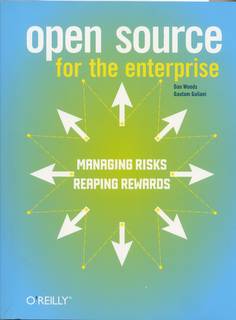
Government of Canada (GC) Managers and directors in the fields of Information Management (IM) and Information Technology (IT) are, unfortunately, all too often unaware of these preliminary guidelines and of the potential for efficiency created by the adoption of open source software. One of the reasons for this shortcoming is lack of knowledge and education. The book "Open Source for the enterprise: Managing Risks - Reaping Rewards", by Dan Woods and Gautam Guliani, goes a long way in convincing the reader that open source software is a viable and cost effective alternative in the enterprise. But not without adequate preparations!

The book opens in Chapter 1 with "The Nature of Open Source". I really like the detailed discussions on topics such as what is open source, where does it come from, how does it grow, how does it die. Chapter 1 ends appropriately with specific consideration of each type of risk associated with open source software and comparing the nature of these risks with comparable risks on the commercial software sector.

Chapter 2 is essential for decision makers in corporate and governmental contexts: "Measuring the Maturity of Open Source". There are clues, factors and best practices one can evaluate in order to develop an informed judgement on the maturity of specific open source software communities. Taking this rational approach moves the use-of-open-source-software-in-the-enterprise discourse away from irrational fears and unfounded beliefs by providing a rational basis for objective evaluation. Using this approach will yield widely varying results depending on the open source software evaluated, reflecting the reality that not all open source software is equal...

Chapter 3 addressesthe open source skill set challenge. Running an IT Department that is resourced to support open source software is different than IT Departments solely responsible for network stability, deployment, upgrades and patches, etc.. The authors describe how to prevent an "open source nightmare" by carefully assessing the skills required as a function of the maturity of the open source software adopted.

Chapters 4, 5, 6 and 7 are helpful and necessary for managers seeking to introduce open source software:
  • Making the ROI Case
  • Designing an Open Source Strategy
  • Support Models for Open Source
  • Making Open Source Projects Easy to Adopt
Chapters 8 and 9 were an eye opener. I knew little of open source licenses. Acronyms such as BSD, GPL, GNU... were alphabet soup. The authors succeed in making the subject not only readable, but very interesting. Chapter 9 alone, on the "SCO Crisis" (when SCO believed it held the original patents and intelectual property rights to Unix and asked all Fortune 500 companies to pay $699 per CPU running Unix), felt more like a novel and should be made into a movie!! You heard it here first... ;-)

The book ends with Chapter 10 on Open Source Empowerment, placing everything into context and giving some insights on how to make it all happen; and with six annexes including helpful reviews of individual open source software packages by categories.

From O'Reilly, ISBN 0-596-10119-8.

Categories:

01 May 2006

Drupal 4.7.0 Released


This is something I have been waiting for with a lot of anticipation! Drupal 4.7.0 has been released. If you're like me and like to read about stuff in books before you dive in, check these Drupal books. I intend to use Drupal to power G2TT and also to explore how it could enable a Web 2.0 environment at work. Spread the word and digg it!

In the annoucement we find out:
After more than a year of development we are ready to release Drupal 4.7.0 to the world. More than five years, 13 major releases, 30+ servicing firms employing 100+ Drupal professionals, 300+ third party modules, and over 55,000+ Drupal powered sites later, Drupal 4.7.0 is finally here and it rocks!

Drupal is an open source content management platform. Equipped with a powerful blend of features, Drupal can support a variety of websites ranging from the personal weblog of Tim Berners-Lee, podcast sites like TWIT.tv, and community driven sites like SpreadFireFox.com, to large media sites like TheOnion.com, and even sites for NASA.

2005 has been explosive for the Drupal community. Drupal.org usage has almost tripled in terms of page views, downloads, and number of users, and with the release of Drupal 4.7.0 we are seeing this new found energy drive the platform development forward at an amazing pace. There have been over 338 contributors to this latest release with over 1500 patches which is almost triple our previous record with Drupal 4.6 of 523 commits by 50 developers. These new contributions are seen in the major usability improvements, new Drupal core functionality, and expansion of the Drupal development framework that will afford themers and contributing developers even greater flexibility and power.


Categories:

27 April 2006

Job Opportunity (Ottawa) - Drupal Programmer / Developer


I have a 5 months (approx) casual employment opportunity to offer - Canadian Federal Government, in Ottawa, CS-02 level. If you are a good and motivated Drupal programmer / developer, or know someone like this; please check my post on drupal.org. A gifted member of my team, François Dupras, is moving on to an acting opportunity elsewhere in the Office of the JAG and I need to replace him (even if you are irreplaceable François) ;-)

This is an exciting opportunity: you can be part of one of the first Canadian Federal Government efforts in using Free and Open Source Software (FOSS) to address a range of information management requirements in a governmental context, in accordance with the applicable federal government guidelines on the use of FOSS. I would expect gosling members to be interested in this opportunity, for example.

Drupal has been featured as the cover story of php architect (vol 4 issue 12 - that would be december 2005 I think). In his article, Titus Barik characterizes Drupal as follows:
Drupal provides a flexible, extensible framework - an alternative to roll-your-own content management solutions. It can be refit for a variety of different content systems, including community portal sites, personal weblogs, and resource directories, simply by adding and removing sophisticated modules.

Drupal offers you a working, tested framework for building components, and handles the insignificant but tedious details of module management, user management, and integration [...]

Unlike a dedicated content system such as WordPress for blogging, or osCommerce for e-commerce, Drupal aims to be flexible, to suit any type of web platform.
Drupal has also been positively commented upon, several times, in the book "Open Source for the Enterprise : Managing Risks, Reaping Rewards" by Dan Woods and Gautam Guliani. I have been impressed by the long list of Drupal-powered web sites, of which I bookmarked a few examples.

Categories:

BarCamp Ottawa in The Ottawa Citizen

BarCamp Ottawa

Check out The Ottawa Citizen today, two full page spreads (and more) on BarCamp Ottawa, pages F1 and F3. Great article written by Peter Hum.

Categories:

22 April 2006

How Blogs are Transforming Legal Scholarship


The Berkman Center for Internet & Society, Harvard Law School, is hosting a free and open to the public symposium on Bloggership: How Blogs are Transforming Legal Scholarship on April 28th, 2006, and a webcast will be available:
Web logs (“blogs”) are transforming much of American society, including government, politics, journalism, and business. In the past few years, blogs have begun to affect the delivery of legal education, the production and dissemination of legal scholarship, and the practice of law. We are delighted that over twenty of the nation’s leading law professor bloggers have agreed to join with us for the first scholarly conference on the impact of blogs on the legal academy.
Thanks to Library Boy (Michel-Adrien Sheppard) for this info!

Categories:

Government 2.0 Think Tank at BarCamp Ottawa

BarCamp Ottawa

Wow! What a day! BarCamp Ottawa was truly mind-invigorating. The following sessions were my favorite. There were others that I would have liked to attend; but many of them were held concurrently, so I had to pick... My favorites:
  • iotum, a successful Canadian startup, currently beta testing and crowned DEMO God in 2006, made a great presentation on "What Makes A Great Demo";
  • Mike Milinkovich, executive director of the eclipse foundation, presented on "Open Source Communities | All About Platforms: Lessons Learned from Eclipse". I was particularly interested in Mike's answer to "How do you create a [successful] community around a platform?" In his words, it takes: (1) great technology; and (2) broad adoption; (3) architecture of participation (I think this ingredient is, perhaps, the most important one); and (4) "hijacked by a fanatic community". A little later in this post I will explain how his presentation will influence the shaping of the G2TT community;
  • Bain McKay, CEO and Chief Scientist of Kayvium, gave a very-forward looking presentation on the semantic web in the context of a desktop application being capable of establishing and navigating semantically meaningful links between information sources, by leveraging ontologies and pattern recognition. On a scale of 0 to 4, 0 representing unorganized information and 2 information organized with taxonomies and controlled vocabularies, Bain talks and lives at the 4 level. I have asked him for a "progressive bibliography" on topic, in other words, what should one read in order to develop a better understanding of the theoretical concepts behind the capabilities Kayvium offers. I will share with you his suggested list of readings when I have it.
I also presented at BarCamp today, in my personal capacity (it has nothing to do with my full time job and employer - I made that disclaimer at the beginning of my presentation), and engaged participants in discussing:
  • Open Source Government. The concept of Open Source Software is explained at wikipedia. To be successful, as Mike Milinkovich from the eclipse foundation suggested, a community built around an open source software must possess several characteristics. Thinking about these characteristics, I was particularly interested in seeking out the opinions of the audience on how to best transpose these "Open Source Software" community characteristics (see for example What makes a good open-source project?) into an "Open Source Government" context, such being the context and community spirit advocated by Government 2.o Think Tank;
  • Government 2.o Think Tank ("G2TT"). G2TT is a not-for-profit private association to be launched in June 2006. G2TT is about open source government, one project at a time. In a sense, it has the potential of being analogous to sourceforge.net, and to be what sourceforge.net is to open source software - by providing an architecture of participation (in Mike Milinkovich words) built around projects instead of software. Instead of code, G2TT projects have, as deliverables, "reports". G2TT projects will always result in the production of complete reports with standard headings (Assumptions, Problems/Challenges, Solutions, Opportunities and Recommendations) and other headings depending on the nature of the project. The first G2TT project is Leveraging Web 2.0 Technologies in Government and you can find its draft Table of Contents here;
  • Leveraging Web 2.0 Technologies in Government (the first G2TT project). Web 2.0 as an Internet phenomenon generally encompasses the collection of trends and technologies enabling the web as a platform and the read/writable web: see this introduction to web 2.0 by Joshua Porter and also these 50+ Web 2.0 resources. Web 2.0 many facets and enablers, such as RSS (resources), Wikis (resources), Blogs (resources), Social Tagging / Enterprise Bookmarking (resources) and Ajax (resources) - among others - collectively constitute a formidable basket of technologies that governments could efficiently leverage both for internal information management and external dialogue with the public they serve. G2TT has chosen to target these technologies and to explain how they could efficiently solve many common problems, such as Email Overload and the difficulty in finding information on intranets.
I wished I had been able to attend Craig Fitzpatrick's presentation, on devshop; but he was presenting at the same time as me. Craig's devshop makes project management specifically for software teams. I recommend, without hesitation, that you get in touch with him if you need project management software in a software development context.

I was pleasantly surprised, at the end of my presentation this afternoon, to see that many participants (including Jason Furlong, Clayton Scott and Ajay Krishnan - thanks to everyone!) pointed out the potential of G2TT in offering a community space in which the Canadian Public could be meaningfully engaged.

On this point, I anticipate G2TT members to debate the acceptable scope of G2TT projects during the first G2TT meeting (signup first if you are interested in attending). I did point out, however, that G2TT had a vested interest in building its credibility with early successes: the association will benefit from selecting and working, initially, on non-contentious projects. For example, the first association project (Leveraging Web 2.0 Technologies in Government) is not about Government Policy "with a big P" but about the exploitation of better information technology to enable better governmental decision-making and improved policy development.

The distinction is important. G2TT does not seek to substitute itself to policy makers and elected officials, it rather attempts to offer insights on how to improve the way government does business, internally and externally, by focusing on specific problems and challenges, one project at a time.

You can follow the progress of G2TT by subscribing to the G2TT RSS feed or to the email subscription service.

Categories:

BarCamp Ottawa | The Evening Before

BarCamp Ottawa

After the gosling pit stop at 16:30, sometime after 19:00 I made my way to Fox & Feather to meet some of the BarCamp Ottawa participants and organizers. Kudos for the Toronto crowd - lots of them came in for the occasion!

I wanted to meet before the conference and have a feel whether I would be an "out-of-context" speaker. It turns out that attendees have a variety of backgrounds. Sure, a lot of programmers and geeks in the crowd - I have never seen so many laptops actively used in during a conference - but a good variety of participants nonetheless.

On BarCamps:
BarCamp is an ad-hoc gathering born from the desire for people to share and learn in an open environment. It is an intense event with discussions, demos, and interaction from attendees. Learn more or organize your own Barcamp!
Next time I'll bring my camera... ;-)


Categories:

gosling community

I met yesterday some folks from the gosling community ("Getting Open Source Logic INto Government"), at their weekly get-together, Black Bear pub, Friday 16:30. I really enjoyed my conversation with Don Kelly and Russell McOrmand.

Don, aside from a shared interest in old games from the Commodore 64 time, made me discover ubuntu - a Linux distribution well suited for "normal people" (read: non-geeks - I like geeks by the way!). He runs it on his laptop and I had a glimpse at it - ubuntu has a very clean and friendly desktop-based user interface.

Russell, aside from his strong opinions on killing Bill C-60 (see also the associated blog), has a wealth of knowledge on open source issues and does not shy away from exploring these issues with a critical mind: I look forward to meeting him again - I learned a lot in an hour with him!!

If you are interested in finding out more about gosling, feel free to drop by in person at the Black Bear pub, any Friday 16:30. I plan to attend again.


Categories:

18 April 2006

Judicial Blogging

I have been following 3L Epiphany posts for a while and I was pleasantly surprised to see that some judges are blogging.

The author has even sent the following survey - two judges have answered and granted permission to publish their answers to the following questions:
  1. When you cited a legal blog, did you consider it unusual or unprecedented at the time?
  2. How often do you read legal blogs?
  3. Which are your favorite legal blogs?
  4. Do you consider blogs to be substantial and legitimate forms of scholarship?
  5. Do you think legal blogs will begin to be cited more often by the courts?
  6. What predictions do you have about the effect of legal blogs on the profession?
  7. What other changes to the legal profession do you foresee because of the Internet and the online world in general?
  8. Do you regularly read law reviews? If so, which are your favorites?
  9. What advantages and disadvantages do legal blogs have when compared to law reviews and other traditional forms of scholarship?
  10. Do you have an opinion about whether law students, lawyers, and/or law professors should blog?
  11. Do you think it is appropriate for judges to blog? If you were to start one, what subject(s) would you write about?
  12. (Off the subject of blogging:) If you could change one thing about the legal educational system, what would it be?
See the answers by Justice Judith Lanzinger (Ohio Sp. Ct.) and by Justice Richard G. Kopf (U.S. District Judge, Nebraska). Fascinating.

[cross posted on slaw]

Categories:

17 April 2006

Number of Blogs Doubling Every Six Months

Amazingly enough, about one blog per second is now created (75,000 per day), the number of blogs is doubling every six months, about 50,000 legitimate posts occur every hour in the blogosphere and almost 20 million (55%) bloggers are still blogging after 3 months. Read all about it in David Sifry's Alerts:


Categories:

14 April 2006

G2TT and BarCamp Ottawa (22 April 2006)

The pregnancy is almost over, by early June 2006, Government 2.0 Think Tank ("G2TT") will officially launch with a Drupal powered web site, ready to tackle its first project - Leveraging Web 2.0 Technologies in the Government of Canada.

Until then, G2TT offers:
If you are interested in G2TT, please use the signup form. If you're in Ottawa, you're also welcome to join us at BarCamp Ottawa, Saturday, April 22nd, all day.

13 April 2006

Favorite Articles on Tagging

I am responding to Bill's invitation (Portals and KM) by offering the following resources.

Here are my favorite resources on social tagging in a corporate context and more on tagging. I have also written on topic a while ago. This article from InfoTangle on Community 2.0 is also well written and I like the many clarifications it offers. The latest I have read about dogear is here (see my comment waayyyy below - it's a long and funny article).

Because social tagging is intricately related to folksonomies, folksonomies resources are also useful to take a look at.

PS: Bill - I had to answer here because your comments do not accept the "a" tag. ;-)

11 April 2006

Object Oriented Editing and Personal Wikis: Wildly Addictive!

I have been extensively using, for over a month, a personal mini-wiki tool called "TiddlyWiki". Do not let the deceptively funny name distract you from its powerful features! Over 3,600 del.icio.us users have bookmarked the original TiddlyWiki site by Jeremy Ruston. Why is it so successful?

A TiddlyWiki is a Free and Open Source, self-contained HTML file. That's it. No software, nothing needed, you can carry it around on a USB stick. It is similar to a wiki because you can create distinct topics that can reference each other. There are many flavours of TiddlyWikis, such as a student edition or the MonkeyPirate edition, or the advanced ELS Studio version.

A TiddlyWiki is incredibly simple to edit and to add new content: see this tutorial by JeremyH. There are a lot of good resources available and a very dynamic Google User Group.

I have used it to create and regularly update this discussion paper. Just as any other technology and solution out there, such as blogs and wikis, TiddlyWikis are not good solutions for all requirements. For example, Wikipedia would never fit in one TiddlyWiki.

TiddlyWikis are great:
  • For small web sites with micro-content;
  • For people (like me) interested in making non-linear papers available online;
  • For students, researchers, anyone wanting to organize personal notes and topics...
...And many more possibilities that you can imagine.

To be used in a Canadian federal government context, a brave soul would need to develop (a) a bilingual plugin (TiddlyWiki features can be significantly augmented with freely available plugins) to facilitate the creation and updates of bilingual tiddlers; and (b) a Common Look & Feel TiddlyWiki.

05 April 2006

Shifting Gears: From Applications to Services

In "Software Out There", John Markoff, from the New York Times, describes how the web has been evolving into a vast array of online services as opposed to desktop applications. When mainstream media finally notices established trends, governments and corporations are more likely to follow suit, especially when considering such priceless quotes (from John's article):
Mr. Ozzie, who used the Firefox browser (an open-source rival to Internet Explorer) during his demonstration, said, "I'm pretty pumped up with the potential for R.S.S. to be the DNA for wiring the Web."

He was referring to Really Simple Syndication, an increasingly popular, free standard used for Internet publishing. Mr. Ozzie's statement was remarkable for a chief technical officer whose company has just spent years and hundreds of millions of dollars investing in a proprietary alternative referred to as .Net.

As posted earlier in The Death of Enteprise Software, John correctly predicts the migration of monolithic desktop and corporate client-server based applications to web based services:
As a result, computer industry innovation is rapidly becoming decentralized. In the place of large, intricate and self-contained programs like Microsoft Word, written and maintained by armies of programmers, smaller companies, with just a handful of developers, are now producing pioneering software and Web-based services. These new services can be delivered directly to PC's or even to cellphones.
John's article also covers (briefly) a few other Web 2.0 technologies such as Ajax.

Reading his article, I discovered the following services:
  • WINKSite. From their site: "In minutes, you can set-up a free mobile site that's available worldwide on any web-enabled phone, PDA or desktop PC. Each mobile site is outfitted with easy-to-use mobile channels including chat, blog, mobile feed reader, surveys, journal, forum, calendar, guestbook, bookmarks, email and more."
  • CastingWords. Human transcription services for audio files, 42 cents a minute. Interesting service for podcasters. Je me demande si ce type de service existe en français!
  • Amazon S3. Storage service for developers priced at 15 cents per GB used per month plus 20 cents per GB of data transferred.

03 April 2006

Supreme Court of Canada: Public Factums?

The Supreme Court of Canada syndicating factums filed in court via RSS feeds available on its web site, subject to a Canadian Creative Commons Attribution - No Derivative - No commercial uses license: fiction or reality?

Thanks to the Canadian Bar Association Supreme Court of Canada Liaison Committee, this issue, framed as "whether it would be worthwile to post Supreme Court factums on a website after the conclusion of cases", is now considered. In order to help moving it along, I would ask lawyers reading this blog to take the survey - it only takes 2 mins: take the survey.

Categories:

01 April 2006

When April 1st Strikes

Funny,

How some news get picked up, even the funny ones. Google Romance is a riot (follow the full explanation!). Scobleizer, Microsoft employee, defecting to Google, instantly attracted lots of buzz in the blogosphere and was picked up by Slashdot.

My all time favorite however is the news that Microsoft, or rather Bill Gates, purchased OpenOffice.org! Attracted lots of attention... because they put it on their home page and will likely disappear tomorrow, here it is:
For an undisclosed sum reputed to be in the billions, Microsoft's Bill Gates has personally bought the leading open-source desktop project. Saying he "was sick and tired of open-source eating away at his profits," the world's richest man decided to put an end to the nuisance and simply buy OpenOffice.org. It will form part of a growing list of Microsoft acquisitions, including several erstwhile competitors, a considerable number of prominent politicians, and a few small governments.

The initially stunned OpenOffice.org community--a happy-go-lucky international band numbering in the hundreds of thousands--later turned to champagne to celebrate their newfound wealth. "Bless Bill!" one happy Torontonian exclaimed, bubbly in hand. "With all this money, I can beat Mark's time in orbit!"

Gates has assured all current OpenOffice.org users that their future migration path to Microsoft Office is guaranteed thanks to OpenOffice.org's faultless support of MS Office files formats. Users can further rest assured that the full functionality currently provided by OpenOffice.org 2.0 will be available in MS-Office 2020 - or possibly 2030.