I just finished reviewing a post by Dion Hinchcliffe called "Thinking in Web 2.0: Sixteen Way", and I could not resist the temptation of adding a 17th Way, for those of us primarily concerned with large governmental and corporate intranets:
17. The Web 2.0 is for governments and corporations too. The world wide web is changing, evolving into a new kind of user experience, leveraging new technologies such as blogs, wikis, RSS, web-based applications using Ajax, and many more technologies. Governmental and Corporate Information Managers need to seriously think and imagine how they could replicate this internet evolution into what we could call intranet revolutions, because, as those of us working in large corporations or governments know, introducing new trends and technologies in large intranets can often prove a formidable challenge, in part due to bureaucracy, diffused information leadership and information management confusion (see the entire post on topic here). Notwithstanding these obstacles, can Information Managers afford not to introduce Web 2.0 into their environments, and run the risk of increasing user experience obsolescence?
26 February 2006
25 February 2006
Social Tagging For The Enterprise
Web 2.0 technologies will promote and enable fundamental changes on intranets. They will alleviate many user "frustrations" with their intranet environment, such as useless search capabilities, email overload, rigid taxonomies, etc.. A peculiar difficulty, however, facing forward-looking IT (or business user) early adopters of Web 2.0 technologies is the fact that Web 2.0 is often "the web as a platform": That web is, currently, mostly the Internet as opposed to intranets. Some resources are only available through an Internet connection. Often, these resources are unavailable due to lack of connectivity to the Internet, corporate firewalls or corporate policy. The larger the corporation, the most likely there will be challenging obstacles.
What of eureka moments, then? How can we exploit moments of clarity when encountering great web 2.0 technologies that feel like a natural extension of the way we "think", of the way we work? One such technology is social tagging (or "social bookmarking"), best exemplified with del.icio.us and many articles illustrating how to best exploit social tagging, such as this one by Marshall Kirkpatrick and this one by Brendon Connelly, and others that go in more depth on topic, such as "Folksonomies: Tidying up Tags?" by Marieke Guy and Emma Tonkin - introduction of the article quoted here:
First, in the corporate environment, IBM has moved forward by developing "dogear", an enterprise-scale social bookmarking system. David Millen, Jonathan Feinberg and Bernard Kerr, from IBM, have written an excellent article based on the following query:
Here is a snapshot dogear's interface:
 Second, another promising way of introducing social bookmarking in a corporate or governmental context is to exploit Free and Open Source Software (FOSS), such as Freetag, released under both BSD and GNU Lesser GPL library license (see license for details):
What of eureka moments, then? How can we exploit moments of clarity when encountering great web 2.0 technologies that feel like a natural extension of the way we "think", of the way we work? One such technology is social tagging (or "social bookmarking"), best exemplified with del.icio.us and many articles illustrating how to best exploit social tagging, such as this one by Marshall Kirkpatrick and this one by Brendon Connelly, and others that go in more depth on topic, such as "Folksonomies: Tidying up Tags?" by Marieke Guy and Emma Tonkin - introduction of the article quoted here:
I have recently come across two interesting options for introducing social tagging into corporate and governmental intranets. The first is a platform developed by IBM, the second is a Free and Open Source Software ("FOSS" - on FOSS in the Canadian Government see the applicable Treasury Board of Canada FOSS guidelines) module for PHP/MySQL applications.A folksonomy is a type of distributed classification system. It is usually created by a group of individuals, typically the resource users. Users add tags to online items, such as images, videos, bookmarks and text. These tags are then shared and sometimes refined. A general review of social bookmarking tools, one popular use area of folksonomies, was given in the April edition of D-Lib [ref omitted]. In the article the authors elaborate on the approach taken by social classification systems and the motivators behind tagging. They write, "...tags are just one kind of metadata and are not a replacement for formal classification systems such as Dublin Core, MODS, etc.... Rather, they are a supplemental means to organise information and order search results."
In this article we look at what makes folksonomies work. We agree with the premise that tags are no replacement for formal systems, but we see this as being the core quality that makes folksonomy tagging so useful. We begin by looking at the issue of "sloppy tags", a problem to which critics of folksonomies are keen to allude, and ask if there are ways the folksonomy community could offset such problems and create systems that are conducive to searching, sorting and classifying. We then go on to question this "tidying up" approach and its underlying assumptions, highlighting issues surrounding removal of low-quality, redundant or nonsense metadata, and the potential risks of tidying too neatly and thereby losing the very openness that has made folksonomies so popular.
First, in the corporate environment, IBM has moved forward by developing "dogear", an enterprise-scale social bookmarking system. David Millen, Jonathan Feinberg and Bernard Kerr, from IBM, have written an excellent article based on the following query:
The apparent success of Internet-based social bookmarking applications begs the question of whether large enterprises or organizations would also benefit from social bookmarking systems. To investigate this question, at IBM we are designing and developing an enterprise-scale social bookmarking system called dogear. The rest of this article describes the design challenges and early lessons learned from a friendly trial of the technology.Their article briefly describes the evolution of personal bookmarks into social bookmarks and the common features of social bookmarking systems. More importantly, the article describes desirable features in order for social bookmarking communities to successfully develop:
- Identity and Transparency. del.icio.us allows users to choose pseudonyms instead of real names. In an enterprise context, IBM has chosen to implement dogear using real names: "real-name identity would facilitate communication among users of the application since the various corporate collaboration tools (e.g., corporate directories, e-mail, chat,) all use real-name identities. There is also a strong cultural norm within the organization to use more formal names within corporate applications." It seems that the IBM team has struck an optimal balance on several decision points for identity and transparency, for example, by enabling both public and private bookmarking and by implementing team-based and role-based collections. I agree with the authors that these decisions are not easy to make. In their own words: "The decisions to use real-name identity and to support private bookmarks were made with some trepidation. The success of social software applications, in general, requires participation to reach critical mass to provide value to users and to ensure a sustainable level of contribution and vibrant interaction. Real-name identity may discourage some people from using the system, and private bookmarks will significantly reduce the benefits of information sharing among users. For a large enterprise, however, we believe that the ability to reach critical mass will not present a problem."
- Alerting and Discovery. A very useful feature of social bookmarking systems consists in being alerted whenever a resource is added by a user, when a resource has been tagged with a keyword of interest, or any combination thereof. del.icio.us offers RSS feeds in order to deliver this requirement. IBM has adopted the same approach, potentially moving the corporate world closed to a 2006 prediction that "everything will get an RSS feed" (see prediction no 5 by Dion Hinchcliffe!)...
- Designing for Extensibility: Enterprise Remixing. The design of the IBM system encourages enterprise remixing "by giving potential exploiters a number of easily parsed data formats from which to choose".
- Exploiting the Links. An enterprise bookmarking system, over time, represents an inherent assessment of valued information resources. Collections of links can be exploited by the enterprise to (a) augment enterprise search applications, as such collections constitute "search collections" within the meaning of this earlier post; (b) supplement directory information about a particular user; and (c) to augment workgroup online content.
Here is a snapshot dogear's interface:
Second, another promising way of introducing social bookmarking in a corporate or governmental context is to exploit Free and Open Source Software (FOSS), such as Freetag, released under both BSD and GNU Lesser GPL library license (see license for details):Freetag is an easy tagging and folksonomy-enabled plugin for use with MySQL-PHP applications. It allows you to create tags on existing database schemas, and access and manage your tags through a robust API.Hopefully, there will be an increasing number of "social bookmarking for the enterprise" options in the coming months.


23 February 2006
LibraryThing Innovates Again
In a previous post, I have written about LibraryThing and described it as follows:
LibraryThing leverages the power of the masses: any LibraryThing user can associate "works" together. The response has been very strong:
LibraryThing is conceptually equivalent to del.icio.us, used to tag web resources, produce tagrolls, see how others have tagged similar content, etc.; but for books.Today, LibraryThing announced how it intends to solve a problem that has plagued librarians and giants like Amazon.com: how to relate comments, recommendations, reviews, ratings, etc. not only to one instance of any given book, but to all instances of the same book, published by different editors.
LibraryThing leverages the power of the masses: any LibraryThing user can associate "works" together. The response has been very strong:
Starting three days ago, I announced a trial project to let users determine what books belonged together, the first time anything like this has been attempted. Using simple check boxes, users could go through a favorite author's works, combining and separating editions as necessary.More information on LibraryThing is available here.
The response has been startling to say the least: In three days, users have combined 17,000 times, mashing together 42,000 works! Users have spent hours at the task, and debated the nuances in a blog post that now sports 182 comments.
22 February 2006
Answers.com Goes Legal

Thanks to LibrarianInBlack for reporting this: answers.com has incorporated two new legal resources - legal biographies and a legal encycopedia.
coCommenting and Managing All Your Comments

After I read a review by Michael Arrington (see the original review and the update), I have decided to try coComment.
With CoComment, you enter your comments throughout the blogosphere as usual, with one exception: just before you submit your comment, you click on the coComment bookmarklet. This sends a copy of your comment to your coComment account. You can then keep track in a central location of all your comments and, more importantly, you can view subsequent comments from others in the same conversations.
In addition, if youhave a blog, coComment offers you the option of adding a widget that shows recent comments.
Unfortunately, coComment does not (yet?) support trackbacks.
21 February 2006
Lawyers Are... Are Not Knowledge Workers?
Just finished my contribution (on slaw) to the subject issue. Comments welcome, preferably over there!
Employees Are the Most Precious Resource... Do Something About It!
The notion of employees as the most precious resource of government and corporations is widely known and accepted. Surprisingly, many employers do not leverage the creativity of their employees, even if the ability of expressing one's creativity is increasingly important.
Fortunately for employees and employers alike, there are ways to engage employees in expressing their creativity and to meaningfully translate ideas into better services, products, profitability. Case in point in a recent post by Toby Ward (as reported by James Robertson): the British Telecom (BT) online idea jar (savings of U$173M over 4 years) and IBM's IDEAS program, generating approx $17M in 2001 alone.
Fortunately for employees and employers alike, there are ways to engage employees in expressing their creativity and to meaningfully translate ideas into better services, products, profitability. Case in point in a recent post by Toby Ward (as reported by James Robertson): the British Telecom (BT) online idea jar (savings of U$173M over 4 years) and IBM's IDEAS program, generating approx $17M in 2001 alone.
National Library of Australia Teaming With Flickr!
What a great concept: a public institution, namely, the National Library of Australia (NLA), is teaming up with flickr.com in order to increase the number of contemporary images in PictureAustralia. Thanks to LibrarianInBlack for reporting this interesting "web 2.0 Public Service / private sector partnership".
As reported in the original NLA post:
As reported in the original NLA post:
Now you can contribute your images to PictureAustralia by loading them into our two groups available on FlickR, PictureAustralia: Australia Day and PictureAustralia: People, places and events.
The PictureAustralia: Australia Day group is a collection of images relating to this day of national significance.
The PictureAustralia: People, places and events group is a collection of images depicting the people, places, and events, which make Australia unique.
Why not search PictureAustralia for a streetscape or town as it looked in the early part of the 20th Century and then capture it as it looks today.
Each week we will collect the metadata (descriptive information) and the thumbnail images from our groups and load them into PictureAustralia, enhancing its value to researchers and the general public. The first load will occur the week following Australia Day 2006.
05 February 2006
Back to Canada - Where Is the Snow?!
 Well, taking one week off in Dominican Republic has a way to make you think about early retirement!!
We went to an all-inclusive resort called Natura Park Resort Eco & Spa, one of the best resorts in the Punta Cana area of Dominican Republic.
What a great time we had! I have temporarily added a flickr badge of our vacation on this blog home page (side bar menu).
27 January 2006
Going Offline and Away!
Gone away to Natura Park Resort Eco & Spa for a week, it's a tough life! Enjoy the snow, if applicable. ;-)


25 January 2006
Contributor to Slaw.ca
As of today, I have joined the slaw.ca team of occasional contributors. From time to time, I will post on slaw.ca some of the content that appears in this blog, edited for the legal profession community - here is an example: "The Uneasy Lawyer and IT Dialogue".
24 January 2006
Web 2.0 and Law 2.0
I have recently come across a very interesting roundtable (from Law Practice TODAY) with Dennis Kennedy, Tom Mighell, John Tredennick, Stephen M. Nipper and Frederick L. Faulkner on the following topics:
- What is Web 2.0
- Examples
- Wikis
- Blogs
- RSS
- Web 2.0 Applications
- What does it mean for lawyers
Pandora v. Last.fm
When I wrote earlier about Pandora, a reader (thanks Mike) suggested that I try last.fm. If you're interested in a comparison between Pandora and last.fm, take a look at the review by Michael Arrington on TechCrunch. Although the post is short, there are lots of insightful comments.
23 January 2006
IMN: Three Subscriptions Are Now Available
Navigating to the end of the right side menu of this blog, on the main page, you can now find three different RSS or email subscriptions for this blog:
Note: posts are also tagged resources - they will show up in the "resources tagged" feed too.
- Only blog posts:
; or email subscription
- Only blog comments:
- Only resources tagged for this blog:
Note: posts are also tagged resources - they will show up in the "resources tagged" feed too.
Building Better Communities Awards (for Libraries)
I once characterized (for fun!) Librarians as "Librarians: I go on managing my collections and serials mindsets", well, think that no more: I really like SirsiDynix new "Building Better Communities Awards", for Libraries (official press release here).
The award recognizes Librarian technology leadership, in service of communities.
It would have been even a better award, I think, if eligibility had not been restricted to "SirsiDynix-powered" Libraries. Although it may seem strange if SirsiDynix were to award a prize to a "non-SirsiDynix" powered Library, on second thoughts, it would make a very lasting impression on the winning Library and would enable all Librarians, proud of their achievements, to apply... Two cents worth from a non-Librarian.
The award recognizes Librarian technology leadership, in service of communities.
It would have been even a better award, I think, if eligibility had not been restricted to "SirsiDynix-powered" Libraries. Although it may seem strange if SirsiDynix were to award a prize to a "non-SirsiDynix" powered Library, on second thoughts, it would make a very lasting impression on the winning Library and would enable all Librarians, proud of their achievements, to apply... Two cents worth from a non-Librarian.
An Excellent Library Catalog Interface: NCSU Libraries
I recently came across the new NCSU Libraries Catalog system (thanks to LibrarianInBlack) and found it the best library catalog interface I have come across to date.
This online catalog is powered by Endeca.
This online catalog is powered by Endeca.
19 January 2006
Wikis In Large Corporations
Since I wrote recently about "The Death of Enteprise Software", I came across an article titled "Wikis: Enabling Effective Knowledge Sharing Across the Organization", by Graeme Foux. This article is symptomatic of a larger trend of moving away from large, cumbersome enterprise software platforms to agile combinations of web-based applications.
I liked Graeme' s article for several reasons, the first being because he offers a simple definition for what is a wiki:
In addition to wikis, more generally, web based applications are also ripe for specific evaluation by large corporations and governments. When comparing the bottom line of well designed Ajax applications as opposed to monolithic enterprise applications, convincingly done by Dion Hinchcliffe in "Why Ajax Is So Disruptive", it is easy to understand why momentum in that direction is building up. Follow the latter link for the full explanation of what Dion considers the "disruptive influences" of Ajax applications on the traditional software world:
IT and its Total-Cost-of-Ownership (TCO) might even represent, again, a fair proportion of the total budget. What an interesting perspective. Web 2.0 and Ajax offer large corporations and governments a genuine strategy for IT rationalization, even resulting in a better information environment for end users. When was the last time that rationalization in large organizations resulted in something better at a lower cost?
I liked Graeme' s article for several reasons, the first being because he offers a simple definition for what is a wiki:
A wiki is an online tool that allows users to update and publish content collaboratively. Anyone who has access can edit the content, using a very simple tool and an ordinary web browser. Wiki usage is known as ‘collaborative authoring’.The article has a clear focus on wikis in corporate settings: how can they be useful? What is the added value? What can you do to make wikis successful? The theme of this article underscores the trend alluded to earlier, that is, web 2.0 technologies - including wikis - are poised in 2006 to be assessed for their usage in large corporations and governments, replacing in part or completely several traditional content management systems.
In addition to wikis, more generally, web based applications are also ripe for specific evaluation by large corporations and governments. When comparing the bottom line of well designed Ajax applications as opposed to monolithic enterprise applications, convincingly done by Dion Hinchcliffe in "Why Ajax Is So Disruptive", it is easy to understand why momentum in that direction is building up. Follow the latter link for the full explanation of what Dion considers the "disruptive influences" of Ajax applications on the traditional software world:
- The End of Software Upgrades, Fixes, and Security Patches;
- Software and Data Available Wherever You Go;
- Isolated Software Can't Compete with Connected Software;
- Deprecation of the Traditional Operating System; and
- Software That Is Invisible.
IT and its Total-Cost-of-Ownership (TCO) might even represent, again, a fair proportion of the total budget. What an interesting perspective. Web 2.0 and Ajax offer large corporations and governments a genuine strategy for IT rationalization, even resulting in a better information environment for end users. When was the last time that rationalization in large organizations resulted in something better at a lower cost?
17 January 2006
U3: Take Your Computing Environment With You
Have you ever wondered how to take with you, on the road, in a tiny USB drive, all your favorite software and files without the need to install anything on the computer you will connect your USB drive to?
Search no more! Take a look at U3. I especially recommend the clear presentation of U3 CEO Kate Purmal, available at the latter link.
Search no more! Take a look at U3. I especially recommend the clear presentation of U3 CEO Kate Purmal, available at the latter link.
16 January 2006
Yet Another Angle on Web 2.0
In the "Must Read" section, I have provided several links to Web 2.0 articles. I have just added another one, by Barb Dybwad, titled "Approaching a definition of Web 2.0". It has more focus on the conceptual aspects of Web 2.0.
14 January 2006
The Relationship Between IT and Business
As I read two recent posts on the subject topic (Business and I.T. Must Work Together to Manage New "Web 2.0" Tools by Dennis D. McDonald and Jeremiah Owyang and The Lawyer-IT Dialogue by Simon Fodden), I realized how much of a universal challenge the relationship is.
All too often, we have an unproductive corporate dialogue that looks like this:

This relationship eventually ends as follows:

Not very productive! It might be more appropriate to insert an intermediary function called "IM" between business users and the IT staff, giving us:

These "models" (thanks to Doug O'Brien, manager at Natural Resources Canada, for sharing his insights on topic in that simple and humoristic form) make several assumptions:
Simon Fodden raises a similar challenge in the context of a law firm here. I wholeheartedly agree with one of his remarks:
All too often, we have an unproductive corporate dialogue that looks like this:

This relationship eventually ends as follows:

Not very productive! It might be more appropriate to insert an intermediary function called "IM" between business users and the IT staff, giving us:
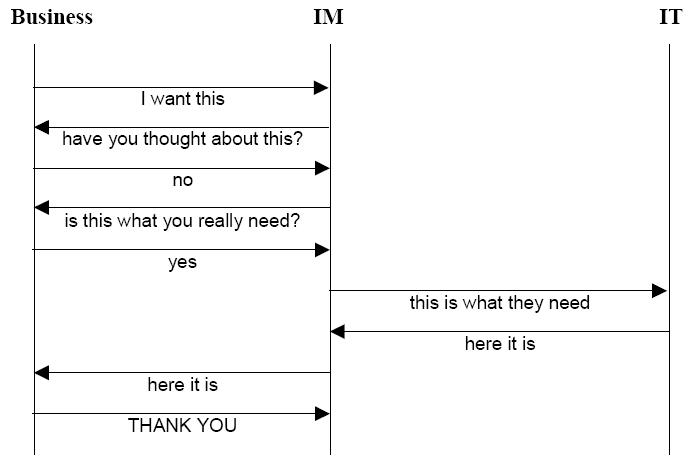
These "models" (thanks to Doug O'Brien, manager at Natural Resources Canada, for sharing his insights on topic in that simple and humoristic form) make several assumptions:
- By "IM", we mean a corporate function that looks at Information Management holistically in which all IM facets are integrated (see Standardized IM Frameworks here), including, for example, records management, access to information & privacy, library services, research services, standards, education, training, so on and so forth;
- By "IT", we mean a corporate function that represents the more traditional Information Technology activities, technical and "problem solving" in nature - networks, hardware and software fleet management, application development, etc.
Simon Fodden raises a similar challenge in the context of a law firm here. I wholeheartedly agree with one of his remarks:
Ideally, there might be a CIO or CKO who has the status of a partner, whether or not she/he is in fact a lawyer-partner. This person would understand both worlds enough to know what questions to ask, what issues to pose, and what policies to impose or recommend. If this truly important mediation role is left to chance, such as when it's dependent on the fact that Mary or Ali, otherwise a librarian or an associate or an office manager, happens to have a background that facilitates things, the firm is vulnerable and may not be putting things on the best footing.Considering knowledge-based organizations and their users thrive on information, it is well worth the investment to have a dedicated IM function and to position IT as an enabler of IM and, in turn, IM as an enabler of the business. The dialogue will improve and rationalization opportunities, matching business requirements, will be easier to identify.
Lesser Known Books on KM
I do not write much about Knowledge Management, but I found this list of "lesser known books on KM" by Larry Prusak, available here, interesting and informative.
13 January 2006
HR: Blogging As A New Required Ability?
As Web 2.0 technologies become more prevalent, I would not be surprised to see the ability to "blog", or to contribute to weblogs, appear in job offers as an ability increasingly sought after... once the legal issues are sorted out. See for example how ZDNet is Looking for a Few Good Bloggers, in a recent post by Bill Ives.
An Example of a Public Law Wiki
Found an interesting law wiki by the Cornell Law School "Legal Information Institute":
Wex is an ambitious effort to construct a collaboratively-created, public-access law dictionary and encyclopedia. It is sponsored and hosted by the Legal Information Institute at the Cornell Law School (http://www.lawschool.cornell.edu/). Much of the material that appears in Wex was originally developed for the LII's "Law about..." pages, to which Wex is the successor.
The Death of Enterprise Software
As reported by James Robertson in his post titled The death of enterprise software, Joe Lamantia has written an interesting piece on "turning away from monolithic and expensive systems with terrible user experiences" (the original post can be found here).
As users increasingly turn away from enterprise systems, they are likely to turn to new trends and technologies that have a proven track record, in particular, solutions that espouses what Dion Hinchcliffe calls "The Timeless Way of Building Software":
Expect an increasing number of conferences exploring how web 2.0 technologies could well serve the workplace, such as this one, and expect a better collaboration between IT staff and business units, as described in this White Paper by Dennis D. McDonald and Jeremiah Owyang (reported here by James Robertson). Finally, Web 2.0 solutions will increasingly target corporate settings, such as Alfresco - an open source, open-standards content repository.
Exciting times ahead in 2006!
As users increasingly turn away from enterprise systems, they are likely to turn to new trends and technologies that have a proven track record, in particular, solutions that espouses what Dion Hinchcliffe calls "The Timeless Way of Building Software":
There is one timeless way of building software. It is decades old and is the same today as it's always been. And because it is timeless, it will always remain this way.If large, neutral and "good for all" enteprise solutions do not obey the above great software characteristics and, at the same time, carefully selected web 2.0 technologies do; the workplace is poised to embrace web 2.0 technologies sooner or later - provided such technologies are carefully selected and orchestrated for deployment in corporate settings. In particular, for large corporations and governments, I agree with Joe Lamantia's prediction:
The great software of our time has always been created by people who were close to this way. It isn't possible to create great software - software that is satisfying, and useful, and makes itself a natural extension of life - except by following this way. And as you will see, this way will lead anyone who looks for it to elegant, vibrant software which is itself timeless in its form.
It is the process by which the function of a piece of software grows directly from the inner nature of people and naturally out of the raw bits, the otherwise meaningless digital medium, of which it is made.
It is a process which allows the life inside a person, or a group of people, or a community to flourish, openly, in freedom, so vividly that it gives rise, of its own accord, to the natural order which is needed to be contained within it.
For enterprise software, I think organizations will turn away from monolithic and expensive systems with terrible user experiences -- and correspondingly low levels of satisfaction, quality, and efficacy -- as the best means of meeting business needs, and shift to a mixed palette of semantically integrated capabilities or services delivered via the Internet. These capabilities will originate from diverse vendors or providers, and expose customized sets of functionality and information specific to the individual enterprise. Staff will access and encounter these capabilities via a multiplicity of channels and user experiences; dashboard or portal style aggregators, RIA rich internet applications, mobile devices, interfaces for RSS and other micro-content formats.End-user experience is not the only driver for this change. The commoditization of IT, a concept coined by Nicholas Carr in "Does IT Matter?", coinciding with organizational self-awareness of massive IM/IT sustained investments as a portion of overall budgets; are pushing for considerable IM/IT rationalization. In one Department for example, the federal government is hoping to save approximately $150M on a yearly basis on the basis of IM/IT rationalization.
Expect an increasing number of conferences exploring how web 2.0 technologies could well serve the workplace, such as this one, and expect a better collaboration between IT staff and business units, as described in this White Paper by Dennis D. McDonald and Jeremiah Owyang (reported here by James Robertson). Finally, Web 2.0 solutions will increasingly target corporate settings, such as Alfresco - an open source, open-standards content repository.
Exciting times ahead in 2006!
31 December 2005
The Cool Musical Side of Web 2.0: Pandora
Who said that web 2.0 stuff needs to be dry and boring and... and...?
See this: Pandora, created by the Music Genome Project. Pandora answers the question "Can you help me discover more music that I'll like?"
By entering a song or artiste directly on the web page, Pandora automatically creates a radio station filled with similar music. Let the station run and work away! It's free. Each added song to one station brings in approximately 100 similar songs, so if you want to adjust the kind of music on any given custom station (you can create up to 100 stations), add songs progressively. By giving a thumb up or thumbs down to any song being played, the selection will improve over time...
Great idea!
See this: Pandora, created by the Music Genome Project. Pandora answers the question "Can you help me discover more music that I'll like?"
By entering a song or artiste directly on the web page, Pandora automatically creates a radio station filled with similar music. Let the station run and work away! It's free. Each added song to one station brings in approximately 100 similar songs, so if you want to adjust the kind of music on any given custom station (you can create up to 100 stations), add songs progressively. By giving a thumb up or thumbs down to any song being played, the selection will improve over time...
Great idea!
Creating Customized Search Collections, or Search Engines
The notion of customized search engines, or "search collections" as defined in an earlier post, already exists and is available to end users - see for example Rollyo, which allows you to "create personal search engines using only the sources you trust".
It shouldn't be too hard to implement a similar concept at the organizational level, For example, in a legal office, good Knowledge Management would imply that a process exists to centrally create, update and maintain subject based search collections. All lawyers using these collections instantly benefit and they can suggest additional search resources to be added to search collections, etc.
PS: On a personal note, I have switched from using Google to Jux2... Search results are more interesting (try it!). A Jux2 Firefox plugin is also available here.
It shouldn't be too hard to implement a similar concept at the organizational level, For example, in a legal office, good Knowledge Management would imply that a process exists to centrally create, update and maintain subject based search collections. All lawyers using these collections instantly benefit and they can suggest additional search resources to be added to search collections, etc.
PS: On a personal note, I have switched from using Google to Jux2... Search results are more interesting (try it!). A Jux2 Firefox plugin is also available here.
Web 2.0 Momentum and Update
Before large corporations and governments start to include web 2.0 technologies in their operations, they have to be convinced that web 2.0 stuff is no fad. Rich Karlgaard of the Forbes magazine has eloquently made the point that a key web 2.0 technology called "blogs" is no fad:
If you know what web 2.0 is all about, you may wonder if executives have found blogging worthwhile, considering several advantages associated with blogging. You may want to know which Fortune 500 companies are blogging: see the list here and the context here, in an article recently posted by Ross Mayfield.
Now, turning to a fundamental question, as reported by Tom Davenport in his post Was Drucker Wrong?:
Blogging is not overhyped. You may be forgiven for thinking so, as no day goes by without a story on blogs. But blogs are no fad. They are cheap and easy to do. And blogs fulfill that deepest of human needs as defined by psychologist Abraham Maslow: self-actualization. People write blogs because they want to know themselves and want to be known by others and because they want their lives to count. When a communications medium is both riding the Moore's Law cost-capability curve and tapping into a deep need, it's no fad.Understanding web 2.0 at a basic level only takes a few minutes if you start with this introduction.
If you know what web 2.0 is all about, you may wonder if executives have found blogging worthwhile, considering several advantages associated with blogging. You may want to know which Fortune 500 companies are blogging: see the list here and the context here, in an article recently posted by Ross Mayfield.
Now, turning to a fundamental question, as reported by Tom Davenport in his post Was Drucker Wrong?:
Are companies doing anything about this?Tom offers a few reasons why companies are slow to adopt web 2.0 technologies, and these reasons equally apply to government. To his reasons (1 to 3), I would add a few (4 to 6):
- It’s hard.
- It takes a fair amount of up-front investment.
- Knowledge workers, like Greta Garbo, like to be left alone.
- Bureaucracy as an obstacle. Large corporations and governments have intricate processes to follow, subjecting the adoption of new technologies and tools to the willingness of many, many public servants, not all of them educated on web 2.0 and its potential. Adopting the technology and authorizing it for use is not the same as leveraging it. For example, the Canadian government has implemented a variety of RSS feeds, but these feeds are seldom updated, because a number of corresponding changes to governmental operations have not been made, in all likelihood due to diffused information leadership, covered next.
- Diffused Information Leadership. Because web 2.0 technologies represent new ways to convey, collaborate with and exploit information (see for example the following link collections on web 2.0, RSS, wikis, Ajax, Aggregators, Blogs, Syndication and Reviews), they literally cut across a significant portion of the Information Management ("IM") problem space. The vast majority of organizations do not have a single point of leadership for the entire problem space, as depicted in the latter link. This prevents a concerted and focused assessment of web 2.0 potential as a key business enabler for the organization. Until such time as Chief Information Officers (CIOs) truthfully own the entire IM problem space, as opposed to merely managing Information Technology, the adoption of web 2.0 technologies will remain slow and painful.
- Information Management Confusion. Lots of people get excited about Ajax, RSS, XML, Web 2.0, KM (Knowledge Management) and other buzz-acronyms. By contrast, Information Management ("IM") does not generate the same excitement and attention, probably because it is so pervasive and vast, especially when approached holistically. This is too bad, because IM, at its root, is (or should be) the key enabler to all knowledge-based organizations. IM does not benefit from standardized tools, methodologies and frameworks. IM does not benefit from a standardized body of knowledge, as project management benefits from the Project Management Body of Knowledge ("PMBOK"), for example. Short of a comprehensive IM discipline, organizations are left to their own ingenuity in tackling that huge IM problem space. Even if a comprehensive discipline and associated integrated IM frameworks were to be deployed, it would take time to assess how to best exploit web 2.0 technologies.
Syndicating Web Content and Standard Feed Icons
Tired of actively monitoring web content? Would you rather have that content delivered by way of subscription? How can you quickly know that your favorite web sites offer such "subscriptions" or, in other words, offer syndicated content?
Web sites offering "syndicated content" is just another way of saying web sites "making content available to users via subscriptions". Up to recently, syndicating content was typically done via offering email subscriptions. Now, a web 2.0 technology called RSS feeds enables web sites to easily syndicate web content.
A standard icon has emerged for identifying RSS feeds. You can find what the icon looks like by following the previous link and the icon is also displayed on the home page of this blog, in the subscription area. This standard icon has been adopted by Microsoft and will be implemented in Microsoft Outlook 12 and Internet Explorer 7.0 (see also this post by the Microsoft RS Team).
Web sites offering "syndicated content" is just another way of saying web sites "making content available to users via subscriptions". Up to recently, syndicating content was typically done via offering email subscriptions. Now, a web 2.0 technology called RSS feeds enables web sites to easily syndicate web content.
A standard icon has emerged for identifying RSS feeds. You can find what the icon looks like by following the previous link and the icon is also displayed on the home page of this blog, in the subscription area. This standard icon has been adopted by Microsoft and will be implemented in Microsoft Outlook 12 and Internet Explorer 7.0 (see also this post by the Microsoft RS Team).
Executive Director - Information Management - Treasury Board Secretariat
If you are in the Public Service of Canada, you can access the following job posting from the governmental intranet. The subject position is currently open to members of the federal public service at the EX-02 level, bilingual imperative and you must apply no later than January 16th, 2006. The position is in Ottawa.
18 December 2005
Christmas Season Upon Us - Going Offline
No posts from now until early January 2006, time for family, friends and downhill skiing! Enjoy your holiday season. Will be back in early January.
Subscribe to:
Posts (Atom)