- Folksonomies 2.0 - The Chaotic Order
- The Evolution of Social Tagging
- Improving Social Bookmarking Granularity
30 March 2006
Interested in Folksonomies?
Anyone interested in deepening one's knowledge of folksonomies, after reading "Tidying up Tags?" by Marieke Guy and Emma Tonkin, should take a look at InfoSpaces, a blog by Emanuele Quintarelli. Emanuele is an Italian information architect with a sharp analytical mind. I recommend, in particular, the following posts authored by him:


29 March 2006
Taxonomy of Legal Blogs
[cross-posted on slaw]
3L Epiphany wrote a very interesting taxonomy of legal bogs. On March 17th, 2006, the list was up to 686 legal blogs, all categorized and sorted. A definite resource for anyone interested to witness how many law blogs, or blawgs, exist out there.
3L Epiphany wrote a very interesting taxonomy of legal bogs. On March 17th, 2006, the list was up to 686 legal blogs, all categorized and sorted. A definite resource for anyone interested to witness how many law blogs, or blawgs, exist out there.
Office 2.0 Applications
I have just read Office 2.0 by Ismael Ghalimi, from IT | Redux - his post is a a great lead into the world of Office 2.0 applications.
Office 2.0 applications enable users to use software online instead of software installed on their desktops. There is now an impressive variety of such applications. Thanks to this list compiled by IT | Redux, you now have access to an extensive directory of Office 2.0 applications with corresponding links to application web sites and reviews by Solution Watch, TechCrunch and IT | Redux.
Office 2.0 applications enable users to use software online instead of software installed on their desktops. There is now an impressive variety of such applications. Thanks to this list compiled by IT | Redux, you now have access to an extensive directory of Office 2.0 applications with corresponding links to application web sites and reviews by Solution Watch, TechCrunch and IT | Redux.
28 March 2006
Gartner Predictions on RSS, Corporate Blogging and Wikis
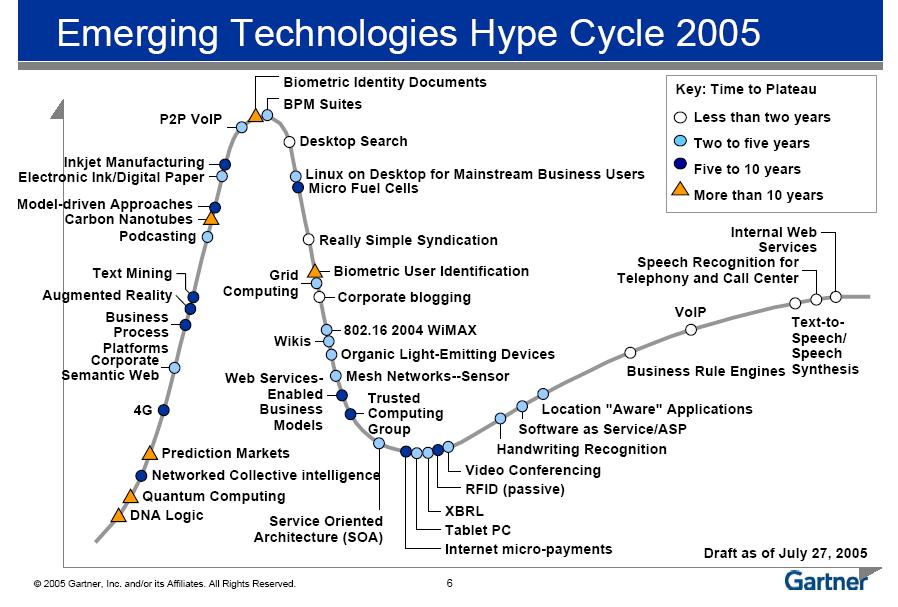
As reported by Cerado, the Gartner Group (see the full report in pdf format) has published their 2005 Hype Cycle, from which we see that RSS and corporate blogging are less than two years away as standard corporate capabilities. Wikis are trailing behind on a 2 to 5 years horizon:
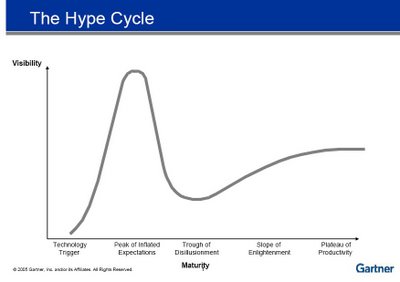
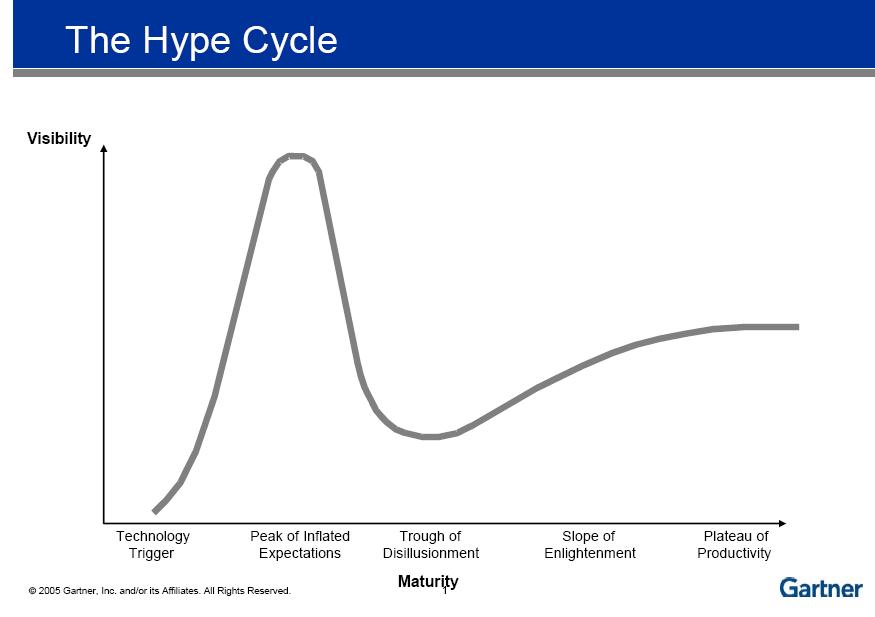
 The Gartner Hype Cycle is a well know, evolution in time depiction of technology trends:
 One thing I can't figure out is why they left out social tagging from their graph...
 The Gartner Hype Cycle is a well know, evolution in time depiction of technology trends:
 One thing I can't figure out is why they left out social tagging from their graph...
23 March 2006
Solving Corporate Email Overload - with blogs
To alleviate email overload in corporate and governmental settings, one can efficiently use subject-based Blogs, a Web 2.0 technology. Mass emails are then re-directed to these subject-based blogs.
Because these blogs are:
Because these blogs are:
- Searchable - both as part of Search Collections and as a web page with a search function;
- Sorted - by definition, each blog will be created and used for one topic and purpose only, therefore the sorting and categorization will occur at the source instead of having thousand users trying to organize this massive traffic themselves in different ways;
- Archived - in the sense that the availability of blog posts will go back farther than the email account creation date. This limitation does not allow users to efficiently go back in time and search. Blogs solve this problem;
- Syndicated - RSS feeds will be associated with each blog, enabling mandatory (based on user category) and optional (based on user interest) subscription;
22 March 2006
The Web 2.0 Enabled Law Firm
[cross-posted on slaw]
For the past several months, I have been diligently exploring how Web 2.0 technologies could better support the work of lawyers. I'm happy to report my findings in this discussion paper, albeit in a particular context, using a TiddlyWiki. If you are interested in what it takes to write a document like this, make sure you check the About section in the paper.
Web 2.0 and the Legal Profession is also specifically discussed.
Comments and suggestions are welcome.
For the past several months, I have been diligently exploring how Web 2.0 technologies could better support the work of lawyers. I'm happy to report my findings in this discussion paper, albeit in a particular context, using a TiddlyWiki. If you are interested in what it takes to write a document like this, make sure you check the About section in the paper.
Web 2.0 and the Legal Profession is also specifically discussed.
Comments and suggestions are welcome.
20 March 2006
Firefox 2.0 (Alpha) Released
An early release of Firefox 2.0 (Alpha) is now available, as reported by Michael Arrington in TechCrunch.
19 March 2006
Over 3,000 People Have Bookmarked These Pages
Since I have started using del.icio.us on December 10th, 2005, I have bookmarked and tagged over 450 Internet pages. 14 of these pages have also been bookmarked by more than 3,000 other people.
Here is the list (the numbers were accurate when I wrote this post):
Here is the list (the numbers were accurate when I wrote this post):
- Quick Online Tips: Absolutely Del.icio.us - Complete Tool Collection (10,855 bookmarks). Not suprisingly, the first resource is a page regularly updated about del.icio.us hacks, plugins, extensions and API's
- script.aculo.us - web 2.0 javascript (9907 bookmarks): "script.aculo.us provides you with easy-to-use, compatible and, ultimately, totally cool JavaScript libraries to
make your web sites and web applications fly, Web 2.0 style" - digg (7762 bookmarks): "Digg is a technology news website that employs non-hierarchical editorial control. With digg, users submit stories for review, but rather than allowing an editor to decide which stories go on the homepage, the users do"
- Last.fm (6961 bookmarks): "You get your own online music profile that you can fill up with the music you like. This information is used to create a personal radio station and to find users who are similar to you. Last.fm can even play you new artists and songs you might like"
- Writely - The Web Word Processor (6016 bookmarks): "Pick exactly who can access your documents. · Upload from Word/OpenOffice & save to your desktop. · Edit your documents anytime, from anywhere." Note: Writely has been purchased by Google
- Prototype JavaScript Framework: Class-style OO, Ajax, and more (5630 bookmarks): "Prototype is a JavaScript framework that aims to ease development of dynamic web applications. Featuring a unique, easy-to-use toolkit for class-driven development and the nicest Ajax library around, Prototype is quickly becoming the codebase of choice for the development of Web applications"
- The Best Web 2.0 Software of 2005 (5289 bookmarks): 2005 Review of the best software, by Dion Hinchliffe
- Yahoo! UI Library (4031 bookmarks): "The Yahoo! User Interface Library is a set of utilities and controls, written in JavaScript, for building richly interactive web applications using techniques such as DOM scripting, HTML and AJAX"
- WordPress › Free Blog Tool and Weblog Platform (3638 bookmarks): "WordPress is a state-of-the-art semantic personal publishing platform with a focus on aesthetics, web standards, and usability. What a mouthful. WordPress is both free and priceless at the same time"
- YouTube - Broadcast Yourself (3617 bookmarks): "Broadcast yourself. Watch and share your videos worldwide!"
- QuirksMode - for all your browser quirks (3560 bookmarks): "contains more than 150 pages with CSS and JavaScript tips and tricks, and is one of the best sources on the WWW for studying and defeating browser incompatibilities"
- TiddlyWiki - a reusable non-linear personal web notebook (3392 bookmarks): A free micro-content and object-oriented editing environment consisting of a JavaScript/HTML page - no software is needed. Note: I will soon publish a series of posts dedicated to TiddlyWikis - I have recently been experimenting with them and I think they are extraordinary
- Feed Icons - Help establish the new standard (3201 bookmarks): New standard icon to be used when identifying syndicated content
- Dojo - DojoToolkit.org (3030 bookmarks): "Dojo is the Open Source JavaScript toolkit that helps you build serious applications in less time. It fills in the gaps where JavaScript and browsers don't go quite far enough, and gives you powerful, portable, lightweight, and tested tools for constructing dynamic interfaces. Dojo lets you prototype interactive widgets quickly, animate transitions, and build Ajax requests with the most powerful and easiest to use abstractions available"
Canoë | Mainstream Media Goes Blogging
Canoë, a francophone Quebec-based mainstream media site, goes blogging (in French a blog is called a "blogue"). Make sure that you scroll down the Canoë Blogs home page, past the latest posts from several blogs, in order to find the blogs.
Some room for improvement:
Overall, a pleasant suprise to see mainstream media en français embracing blogging (timidly!), even if a few quirks need sorting out.
Some room for improvement:
- Canoë ought to implement trackbacks in their blogs. Only comments seem to be supported at this time;
- Permalinks should be more clearly accessible. Not all readers will know that they have to click the "comments" hyperlink in order to access to permanent link to the URL post, etc.;
- On this note, some of the links in the "previous posts" section do not seem to be properly coded. For example, when I tried to access a post "Petit délice d'un..." in Jasmine's blog, although the browser displayed a permalink - that link took me to her blog home page.
Overall, a pleasant suprise to see mainstream media en français embracing blogging (timidly!), even if a few quirks need sorting out.
13 March 2006
How To Poison Your Career
From time to time my readings take me on various tangents, and this time I ended up on a blog I had not previously visited, on this article: 10 Ways to Poison Your Career. It's fun... and truthful! Take a look - well written and insightful.
12 March 2006
Social Tagging Makes It to A Mainstream Library
Social Tagging, or bookmarking, develops over time a folksonomy (as opposed to more rigid corporate taxonomies). LibraryThing, for example, successfully exploits this concept in the realm of books, to the delight of their users.
Recently, it seems that social bookmarking made it in the world of mainstream libraries: have a look at this library item in the online catalog of the Penn Library. They also have LiveChat support. That rocks! Thanks to "UPenn Catalog Tagging" by Steven M. Cohen for reporting this.
I strongly believe in the usefulness of social bookmarking in the enterprise context. Hopefully, we will see in the coming year an increasing number of examples where mainstream institutions are embracing enterprise bookmarking.
Recently, it seems that social bookmarking made it in the world of mainstream libraries: have a look at this library item in the online catalog of the Penn Library. They also have LiveChat support. That rocks! Thanks to "UPenn Catalog Tagging" by Steven M. Cohen for reporting this.
I strongly believe in the usefulness of social bookmarking in the enterprise context. Hopefully, we will see in the coming year an increasing number of examples where mainstream institutions are embracing enterprise bookmarking.
11 March 2006
Using Siteground As Web 2.0 Playground (Wikis, Blogs, CMS...)
It is bound to happen: after you have been exposed to a zillion bright ideas for blogging platforms, wikis, different Content Managements Systems; at some point, you want to start your own site, your own wiki, your own blog... Wait, start what exactly?! What if you're not sure, or what if you want a wiki and a blog and... and...?
I recently found myself in this situation. I want to start a private association and provide its members with an online community. Because of the nature of the association, I immediately thought of using a wiki. What wiki to use, then? Wiki Software to install on your own server was out of the question, so I started looking for a hosted wiki solution, such as Stikipad, Foopad or PBWiki. I even tried Stikipad a little. But I then realized: why not use, for my space, the same software powering Wikipedia? After all, if it works for that; it would sure work for my small community. Wikipedia is powered by MediaWiki, a free software package originally written for Wikipedia, but also powering other wikis now.
After some research, I finally settled for Siteground at $5 a month. What initially turned out as a requirement for a "password-protected MediaWiki hosted solution" morphed into a "why not a Web 2.0 (and more) hosted playground". Why? Take a look a this.
Upon registration to Siteground, you can also register a domain name.
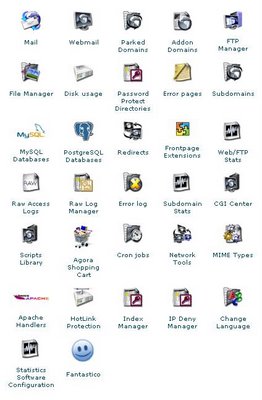
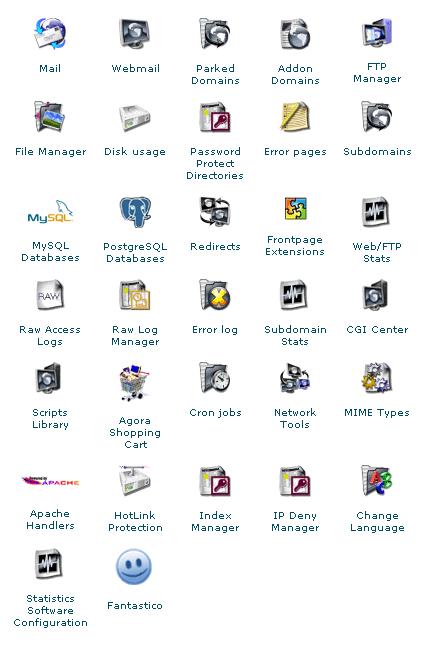
What I realized, with Siteground, is that you have access to a lot of features via the C-Panel. What you see opposite is a partial screenshot from the C-Panel, giving you an idea of the control you have over your web site. I draw your attention to the subdomains icon (last 2nd row): by adding subdomains such as "wiki.domain.(whatever)", "blog.domain.(whatever), "forum.domain.(whatever)", etc.; you can create as many subdomains you wish and start experimenting with blogs, wikis, bulletin boards or forums; and I suggest that you keep your root directory ("www.domain.(whatever)") for a Content Management System (CMS).
Until such time as a CMS will offer a truly integrated and ideal mix of traditional CMS / wiki / blog / etc (what an idealistic notion); this approach works for me, especially at a total of $5 per month.
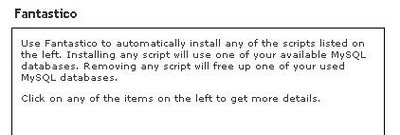
The last icon on the C-Panel is Fantastico. Fantastico allows you to automatically install an impressive array of hosted applications.
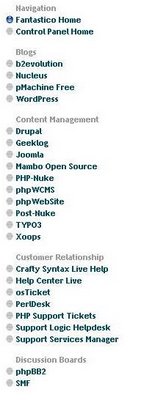
As you can see from the list opposite (partial list), there are several blogging platforms (including WordPress) and a wide range of Content Management Systems (incidentally I just found out that socialtext web site - an enterprise blogging platform - is now powered by Drupal which is available in the Siteground C-Panel CMS list).
I admit that I toyed with the notion of diving right away into CMS installation and deployment, especially when I looked at intuitive user interfaces such as the TYPO3 UI. Upon further reading, I realized I was probably overextending myself, about TYPO3 anyway - typo3.org recommends a month to learn the software:
I have to do further reading though on Drupal and its CivicSpace distinct distribution in order to develop a realistic appreciation of what it takes to deploy and maintain a community website. For that purpose I have ordered "Building Online Communities With Drupal, phpBB, and WordPress" by Robert T. Douglass, Mike Little and Jared W. Smith.
The Fantastico list continues like this (and even more that did not fit in my "print screen"):
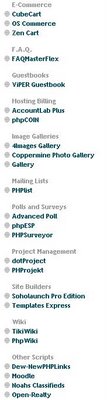
From E-commerce, FAQ, guestbooks, polls & surveys to site bulder and wiki scripts; the list goes on. It is also possible to install other applications on the server but the list here is a very good start for people without a definite idea of what they want to use.
I should also conclude by saying that I appreciated the quick turnaround time from Customer Support, both pre-sales (using their online chat system) and after-sales technical support on two occasions. First ticket was answered in 30 mins and the second one in 20 mins, both tickets were routine.
At some point I plan to migrate this blog, currently hosted on blogspot.com, to a Wordpress platform. I'm not really sure how yet, but I think Drupal allows each community member to have its own blog, something I will check further. If you know of a good "how-to" guide to wisely deploy and manage the CivicSpace distribution of Drupal, please let me know!!
To-do list for the next little while:
I recently found myself in this situation. I want to start a private association and provide its members with an online community. Because of the nature of the association, I immediately thought of using a wiki. What wiki to use, then? Wiki Software to install on your own server was out of the question, so I started looking for a hosted wiki solution, such as Stikipad, Foopad or PBWiki. I even tried Stikipad a little. But I then realized: why not use, for my space, the same software powering Wikipedia? After all, if it works for that; it would sure work for my small community. Wikipedia is powered by MediaWiki, a free software package originally written for Wikipedia, but also powering other wikis now.
After some research, I finally settled for Siteground at $5 a month. What initially turned out as a requirement for a "password-protected MediaWiki hosted solution" morphed into a "why not a Web 2.0 (and more) hosted playground". Why? Take a look a this.
Upon registration to Siteground, you can also register a domain name.
What I realized, with Siteground, is that you have access to a lot of features via the C-Panel. What you see opposite is a partial screenshot from the C-Panel, giving you an idea of the control you have over your web site. I draw your attention to the subdomains icon (last 2nd row): by adding subdomains such as "wiki.domain.(whatever)", "blog.domain.(whatever), "forum.domain.(whatever)", etc.; you can create as many subdomains you wish and start experimenting with blogs, wikis, bulletin boards or forums; and I suggest that you keep your root directory ("www.domain.(whatever)") for a Content Management System (CMS).
Until such time as a CMS will offer a truly integrated and ideal mix of traditional CMS / wiki / blog / etc (what an idealistic notion); this approach works for me, especially at a total of $5 per month.
The last icon on the C-Panel is Fantastico. Fantastico allows you to automatically install an impressive array of hosted applications.


As you can see from the list opposite (partial list), there are several blogging platforms (including WordPress) and a wide range of Content Management Systems (incidentally I just found out that socialtext web site - an enterprise blogging platform - is now powered by Drupal which is available in the Siteground C-Panel CMS list).
I admit that I toyed with the notion of diving right away into CMS installation and deployment, especially when I looked at intuitive user interfaces such as the TYPO3 UI. Upon further reading, I realized I was probably overextending myself, about TYPO3 anyway - typo3.org recommends a month to learn the software:
Be aware that all the flexibility and richness come with a price: complexity. If you're not ready to spend a month learning the system and are in a hurry to satisfy a customer, you should probably look into getting somebody to help you or look for something else.I looked then at Mambo and Joomla and found them to be closely related, for obvious reasons. Considering the history of both products, I would prefer Joomla. Its online manual seems satisfactory.
I have to do further reading though on Drupal and its CivicSpace distinct distribution in order to develop a realistic appreciation of what it takes to deploy and maintain a community website. For that purpose I have ordered "Building Online Communities With Drupal, phpBB, and WordPress" by Robert T. Douglass, Mike Little and Jared W. Smith.
The Fantastico list continues like this (and even more that did not fit in my "print screen"):
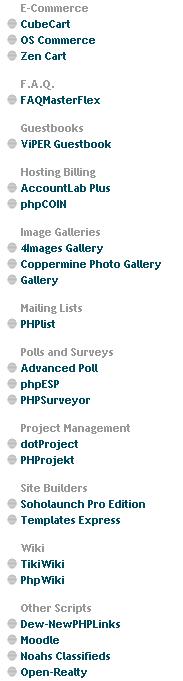
From E-commerce, FAQ, guestbooks, polls & surveys to site bulder and wiki scripts; the list goes on. It is also possible to install other applications on the server but the list here is a very good start for people without a definite idea of what they want to use.
I should also conclude by saying that I appreciated the quick turnaround time from Customer Support, both pre-sales (using their online chat system) and after-sales technical support on two occasions. First ticket was answered in 30 mins and the second one in 20 mins, both tickets were routine.
At some point I plan to migrate this blog, currently hosted on blogspot.com, to a Wordpress platform. I'm not really sure how yet, but I think Drupal allows each community member to have its own blog, something I will check further. If you know of a good "how-to" guide to wisely deploy and manage the CivicSpace distribution of Drupal, please let me know!!
To-do list for the next little while:
- Continue blogging... perhaps less frequently so because of -
- Develop the "Government 2.0 Think Tank" private association wiki, enough anyway to sart recruiting its founding members and get our first project going ("Leveraging Web 2.0 Technologies in the Government of Canada"). Note: membership in this association will be restricted to Public Servants at the federal, provincial and municipal levels and to academics without private industry ties.
- Investigate and choose CMS/Blogging/Forum platforms for the association, deploy them.
05 March 2006
Who Needs A Library, Anyway?
Students and the Public need libraries, fair enough: schools, universities, cities, villages... When the Grande Bibliothèque du Québec (official web site here) was planned, I would have preferred to see the total project cost (Cdn$90M) injected into a "book acquisition revitalization program", allowing local libraries, especially in remote areas of Québec; to revitalize their collections - especially books for children. That story and the shifting uses of corporate libraries prompted me to think of the continued relevance of corporate and governmental libraries: do we need them?
The question becomes increasingly difficult to answer in corporate and governmental settings, because of workstation access to relevant information. The 21st century knowledge workers in corporations and governments have access to more and more information right from their desktops: why walk to their "in-house" libraries?
Well, for starters, one of the good answers is not very scientific but resonates true - see this recent post by Amanda Robertson:
I thoroughly enjoyed the issues and discussion on topic as presented in "paved paradise: the future of (a particular type of) research library?" by Richard Akerman (thanks Amanda for the link). Highly recommended reading. I really liked this part:
The question becomes increasingly difficult to answer in corporate and governmental settings, because of workstation access to relevant information. The 21st century knowledge workers in corporations and governments have access to more and more information right from their desktops: why walk to their "in-house" libraries?
Well, for starters, one of the good answers is not very scientific but resonates true - see this recent post by Amanda Robertson:
I think any librarian would agree that the most important part of the library isn’t the materials contained within but how they are used. (...) [Patrons] certainly want the instant desktop access of electronic copies, particularly when it comes to reusing data from other in-house work. But they also want the copy in paper, and many of them can’t yet imagine keeping up with the industry by reading e-journals.Serendipity is fine. However, as powerful electronic search, discovery and retrieval methods become available; the never-to-stop quest for governmental and corporate cost efficiency will result in second-guessing the existence of several corporate and governmental libraries, especially in settings where the community served is article-centric.
Additionally, many of them use the library serendipidously. They poke their head in the door and ask me where petroleum technology materials are shelved. I show them, and they browse through the shelves. Sometimes they find something they wouldn’t have noticed when searching the OPAC.
I thoroughly enjoyed the issues and discussion on topic as presented in "paved paradise: the future of (a particular type of) research library?" by Richard Akerman (thanks Amanda for the link). Highly recommended reading. I really liked this part:
When I said "pave over the library" it got read I think as "pave over the librarians". To me, librarianship and librarians are completely separate from their current physical container, the library. You could pave over the library and still have as many or more librarians providing services, just from different locations, e.g. co-located with the researchers.The article by Richard is thoughtful, beginning to end, and the comments are worth reading too.My fundamental argument is more around holdings, and how they are presented. Firstly, is it true that the sciences mentioned above are article-centric? If they are, then
1. Why would I use as my primary research tool a giant physical container of lifeless, non-searchable paper articles that I have to request and wait for, rather than having live articles online that I can access instantly, with clickable linked citations, interconnections to data, and all sorts of wonderful electronic goodness?
2. Why is the library's website book-catalogue based, or journal-title-based, rather than putting full-text articles front and centre?Also, to make it worse, is it true that science is moving beyond just articles to becoming data-centric as well? If so, where is the library transformation to data-centricity?
26 February 2006
Thinking in Web 2.0: The 17th Way
I just finished reviewing a post by Dion Hinchcliffe called "Thinking in Web 2.0: Sixteen Way", and I could not resist the temptation of adding a 17th Way, for those of us primarily concerned with large governmental and corporate intranets:
17. The Web 2.0 is for governments and corporations too. The world wide web is changing, evolving into a new kind of user experience, leveraging new technologies such as blogs, wikis, RSS, web-based applications using Ajax, and many more technologies. Governmental and Corporate Information Managers need to seriously think and imagine how they could replicate this internet evolution into what we could call intranet revolutions, because, as those of us working in large corporations or governments know, introducing new trends and technologies in large intranets can often prove a formidable challenge, in part due to bureaucracy, diffused information leadership and information management confusion (see the entire post on topic here). Notwithstanding these obstacles, can Information Managers afford not to introduce Web 2.0 into their environments, and run the risk of increasing user experience obsolescence?
17. The Web 2.0 is for governments and corporations too. The world wide web is changing, evolving into a new kind of user experience, leveraging new technologies such as blogs, wikis, RSS, web-based applications using Ajax, and many more technologies. Governmental and Corporate Information Managers need to seriously think and imagine how they could replicate this internet evolution into what we could call intranet revolutions, because, as those of us working in large corporations or governments know, introducing new trends and technologies in large intranets can often prove a formidable challenge, in part due to bureaucracy, diffused information leadership and information management confusion (see the entire post on topic here). Notwithstanding these obstacles, can Information Managers afford not to introduce Web 2.0 into their environments, and run the risk of increasing user experience obsolescence?
25 February 2006
Social Tagging For The Enterprise
Web 2.0 technologies will promote and enable fundamental changes on intranets. They will alleviate many user "frustrations" with their intranet environment, such as useless search capabilities, email overload, rigid taxonomies, etc.. A peculiar difficulty, however, facing forward-looking IT (or business user) early adopters of Web 2.0 technologies is the fact that Web 2.0 is often "the web as a platform": That web is, currently, mostly the Internet as opposed to intranets. Some resources are only available through an Internet connection. Often, these resources are unavailable due to lack of connectivity to the Internet, corporate firewalls or corporate policy. The larger the corporation, the most likely there will be challenging obstacles.
What of eureka moments, then? How can we exploit moments of clarity when encountering great web 2.0 technologies that feel like a natural extension of the way we "think", of the way we work? One such technology is social tagging (or "social bookmarking"), best exemplified with del.icio.us and many articles illustrating how to best exploit social tagging, such as this one by Marshall Kirkpatrick and this one by Brendon Connelly, and others that go in more depth on topic, such as "Folksonomies: Tidying up Tags?" by Marieke Guy and Emma Tonkin - introduction of the article quoted here:
First, in the corporate environment, IBM has moved forward by developing "dogear", an enterprise-scale social bookmarking system. David Millen, Jonathan Feinberg and Bernard Kerr, from IBM, have written an excellent article based on the following query:
Here is a snapshot dogear's interface:
 Second, another promising way of introducing social bookmarking in a corporate or governmental context is to exploit Free and Open Source Software (FOSS), such as Freetag, released under both BSD and GNU Lesser GPL library license (see license for details):
What of eureka moments, then? How can we exploit moments of clarity when encountering great web 2.0 technologies that feel like a natural extension of the way we "think", of the way we work? One such technology is social tagging (or "social bookmarking"), best exemplified with del.icio.us and many articles illustrating how to best exploit social tagging, such as this one by Marshall Kirkpatrick and this one by Brendon Connelly, and others that go in more depth on topic, such as "Folksonomies: Tidying up Tags?" by Marieke Guy and Emma Tonkin - introduction of the article quoted here:
I have recently come across two interesting options for introducing social tagging into corporate and governmental intranets. The first is a platform developed by IBM, the second is a Free and Open Source Software ("FOSS" - on FOSS in the Canadian Government see the applicable Treasury Board of Canada FOSS guidelines) module for PHP/MySQL applications.A folksonomy is a type of distributed classification system. It is usually created by a group of individuals, typically the resource users. Users add tags to online items, such as images, videos, bookmarks and text. These tags are then shared and sometimes refined. A general review of social bookmarking tools, one popular use area of folksonomies, was given in the April edition of D-Lib [ref omitted]. In the article the authors elaborate on the approach taken by social classification systems and the motivators behind tagging. They write, "...tags are just one kind of metadata and are not a replacement for formal classification systems such as Dublin Core, MODS, etc.... Rather, they are a supplemental means to organise information and order search results."
In this article we look at what makes folksonomies work. We agree with the premise that tags are no replacement for formal systems, but we see this as being the core quality that makes folksonomy tagging so useful. We begin by looking at the issue of "sloppy tags", a problem to which critics of folksonomies are keen to allude, and ask if there are ways the folksonomy community could offset such problems and create systems that are conducive to searching, sorting and classifying. We then go on to question this "tidying up" approach and its underlying assumptions, highlighting issues surrounding removal of low-quality, redundant or nonsense metadata, and the potential risks of tidying too neatly and thereby losing the very openness that has made folksonomies so popular.
First, in the corporate environment, IBM has moved forward by developing "dogear", an enterprise-scale social bookmarking system. David Millen, Jonathan Feinberg and Bernard Kerr, from IBM, have written an excellent article based on the following query:
The apparent success of Internet-based social bookmarking applications begs the question of whether large enterprises or organizations would also benefit from social bookmarking systems. To investigate this question, at IBM we are designing and developing an enterprise-scale social bookmarking system called dogear. The rest of this article describes the design challenges and early lessons learned from a friendly trial of the technology.Their article briefly describes the evolution of personal bookmarks into social bookmarks and the common features of social bookmarking systems. More importantly, the article describes desirable features in order for social bookmarking communities to successfully develop:
- Identity and Transparency. del.icio.us allows users to choose pseudonyms instead of real names. In an enterprise context, IBM has chosen to implement dogear using real names: "real-name identity would facilitate communication among users of the application since the various corporate collaboration tools (e.g., corporate directories, e-mail, chat,) all use real-name identities. There is also a strong cultural norm within the organization to use more formal names within corporate applications." It seems that the IBM team has struck an optimal balance on several decision points for identity and transparency, for example, by enabling both public and private bookmarking and by implementing team-based and role-based collections. I agree with the authors that these decisions are not easy to make. In their own words: "The decisions to use real-name identity and to support private bookmarks were made with some trepidation. The success of social software applications, in general, requires participation to reach critical mass to provide value to users and to ensure a sustainable level of contribution and vibrant interaction. Real-name identity may discourage some people from using the system, and private bookmarks will significantly reduce the benefits of information sharing among users. For a large enterprise, however, we believe that the ability to reach critical mass will not present a problem."
- Alerting and Discovery. A very useful feature of social bookmarking systems consists in being alerted whenever a resource is added by a user, when a resource has been tagged with a keyword of interest, or any combination thereof. del.icio.us offers RSS feeds in order to deliver this requirement. IBM has adopted the same approach, potentially moving the corporate world closed to a 2006 prediction that "everything will get an RSS feed" (see prediction no 5 by Dion Hinchcliffe!)...
- Designing for Extensibility: Enterprise Remixing. The design of the IBM system encourages enterprise remixing "by giving potential exploiters a number of easily parsed data formats from which to choose".
- Exploiting the Links. An enterprise bookmarking system, over time, represents an inherent assessment of valued information resources. Collections of links can be exploited by the enterprise to (a) augment enterprise search applications, as such collections constitute "search collections" within the meaning of this earlier post; (b) supplement directory information about a particular user; and (c) to augment workgroup online content.
Here is a snapshot dogear's interface:
Second, another promising way of introducing social bookmarking in a corporate or governmental context is to exploit Free and Open Source Software (FOSS), such as Freetag, released under both BSD and GNU Lesser GPL library license (see license for details):Freetag is an easy tagging and folksonomy-enabled plugin for use with MySQL-PHP applications. It allows you to create tags on existing database schemas, and access and manage your tags through a robust API.Hopefully, there will be an increasing number of "social bookmarking for the enterprise" options in the coming months.
23 February 2006
LibraryThing Innovates Again
In a previous post, I have written about LibraryThing and described it as follows:
LibraryThing leverages the power of the masses: any LibraryThing user can associate "works" together. The response has been very strong:
LibraryThing is conceptually equivalent to del.icio.us, used to tag web resources, produce tagrolls, see how others have tagged similar content, etc.; but for books.Today, LibraryThing announced how it intends to solve a problem that has plagued librarians and giants like Amazon.com: how to relate comments, recommendations, reviews, ratings, etc. not only to one instance of any given book, but to all instances of the same book, published by different editors.
LibraryThing leverages the power of the masses: any LibraryThing user can associate "works" together. The response has been very strong:
Starting three days ago, I announced a trial project to let users determine what books belonged together, the first time anything like this has been attempted. Using simple check boxes, users could go through a favorite author's works, combining and separating editions as necessary.More information on LibraryThing is available here.
The response has been startling to say the least: In three days, users have combined 17,000 times, mashing together 42,000 works! Users have spent hours at the task, and debated the nuances in a blog post that now sports 182 comments.
22 February 2006
Answers.com Goes Legal

Thanks to LibrarianInBlack for reporting this: answers.com has incorporated two new legal resources - legal biographies and a legal encycopedia.
coCommenting and Managing All Your Comments

After I read a review by Michael Arrington (see the original review and the update), I have decided to try coComment.
With CoComment, you enter your comments throughout the blogosphere as usual, with one exception: just before you submit your comment, you click on the coComment bookmarklet. This sends a copy of your comment to your coComment account. You can then keep track in a central location of all your comments and, more importantly, you can view subsequent comments from others in the same conversations.
In addition, if youhave a blog, coComment offers you the option of adding a widget that shows recent comments.
Unfortunately, coComment does not (yet?) support trackbacks.
21 February 2006
Lawyers Are... Are Not Knowledge Workers?
Just finished my contribution (on slaw) to the subject issue. Comments welcome, preferably over there!
Employees Are the Most Precious Resource... Do Something About It!
The notion of employees as the most precious resource of government and corporations is widely known and accepted. Surprisingly, many employers do not leverage the creativity of their employees, even if the ability of expressing one's creativity is increasingly important.
Fortunately for employees and employers alike, there are ways to engage employees in expressing their creativity and to meaningfully translate ideas into better services, products, profitability. Case in point in a recent post by Toby Ward (as reported by James Robertson): the British Telecom (BT) online idea jar (savings of U$173M over 4 years) and IBM's IDEAS program, generating approx $17M in 2001 alone.
Fortunately for employees and employers alike, there are ways to engage employees in expressing their creativity and to meaningfully translate ideas into better services, products, profitability. Case in point in a recent post by Toby Ward (as reported by James Robertson): the British Telecom (BT) online idea jar (savings of U$173M over 4 years) and IBM's IDEAS program, generating approx $17M in 2001 alone.
National Library of Australia Teaming With Flickr!
What a great concept: a public institution, namely, the National Library of Australia (NLA), is teaming up with flickr.com in order to increase the number of contemporary images in PictureAustralia. Thanks to LibrarianInBlack for reporting this interesting "web 2.0 Public Service / private sector partnership".
As reported in the original NLA post:
As reported in the original NLA post:
Now you can contribute your images to PictureAustralia by loading them into our two groups available on FlickR, PictureAustralia: Australia Day and PictureAustralia: People, places and events.
The PictureAustralia: Australia Day group is a collection of images relating to this day of national significance.
The PictureAustralia: People, places and events group is a collection of images depicting the people, places, and events, which make Australia unique.
Why not search PictureAustralia for a streetscape or town as it looked in the early part of the 20th Century and then capture it as it looks today.
Each week we will collect the metadata (descriptive information) and the thumbnail images from our groups and load them into PictureAustralia, enhancing its value to researchers and the general public. The first load will occur the week following Australia Day 2006.
05 February 2006
Back to Canada - Where Is the Snow?!
 Well, taking one week off in Dominican Republic has a way to make you think about early retirement!!
We went to an all-inclusive resort called Natura Park Resort Eco & Spa, one of the best resorts in the Punta Cana area of Dominican Republic.
What a great time we had! I have temporarily added a flickr badge of our vacation on this blog home page (side bar menu).
27 January 2006
Going Offline and Away!
Gone away to Natura Park Resort Eco & Spa for a week, it's a tough life! Enjoy the snow, if applicable. ;-)


25 January 2006
Contributor to Slaw.ca
As of today, I have joined the slaw.ca team of occasional contributors. From time to time, I will post on slaw.ca some of the content that appears in this blog, edited for the legal profession community - here is an example: "The Uneasy Lawyer and IT Dialogue".
24 January 2006
Web 2.0 and Law 2.0
I have recently come across a very interesting roundtable (from Law Practice TODAY) with Dennis Kennedy, Tom Mighell, John Tredennick, Stephen M. Nipper and Frederick L. Faulkner on the following topics:
- What is Web 2.0
- Examples
- Wikis
- Blogs
- RSS
- Web 2.0 Applications
- What does it mean for lawyers
Pandora v. Last.fm
When I wrote earlier about Pandora, a reader (thanks Mike) suggested that I try last.fm. If you're interested in a comparison between Pandora and last.fm, take a look at the review by Michael Arrington on TechCrunch. Although the post is short, there are lots of insightful comments.
23 January 2006
IMN: Three Subscriptions Are Now Available
Navigating to the end of the right side menu of this blog, on the main page, you can now find three different RSS or email subscriptions for this blog:
Note: posts are also tagged resources - they will show up in the "resources tagged" feed too.
- Only blog posts:
; or email subscription
- Only blog comments:
- Only resources tagged for this blog:
Note: posts are also tagged resources - they will show up in the "resources tagged" feed too.
Building Better Communities Awards (for Libraries)
I once characterized (for fun!) Librarians as "Librarians: I go on managing my collections and serials mindsets", well, think that no more: I really like SirsiDynix new "Building Better Communities Awards", for Libraries (official press release here).
The award recognizes Librarian technology leadership, in service of communities.
It would have been even a better award, I think, if eligibility had not been restricted to "SirsiDynix-powered" Libraries. Although it may seem strange if SirsiDynix were to award a prize to a "non-SirsiDynix" powered Library, on second thoughts, it would make a very lasting impression on the winning Library and would enable all Librarians, proud of their achievements, to apply... Two cents worth from a non-Librarian.
The award recognizes Librarian technology leadership, in service of communities.
It would have been even a better award, I think, if eligibility had not been restricted to "SirsiDynix-powered" Libraries. Although it may seem strange if SirsiDynix were to award a prize to a "non-SirsiDynix" powered Library, on second thoughts, it would make a very lasting impression on the winning Library and would enable all Librarians, proud of their achievements, to apply... Two cents worth from a non-Librarian.
An Excellent Library Catalog Interface: NCSU Libraries
I recently came across the new NCSU Libraries Catalog system (thanks to LibrarianInBlack) and found it the best library catalog interface I have come across to date.
This online catalog is powered by Endeca.
This online catalog is powered by Endeca.
19 January 2006
Wikis In Large Corporations
Since I wrote recently about "The Death of Enteprise Software", I came across an article titled "Wikis: Enabling Effective Knowledge Sharing Across the Organization", by Graeme Foux. This article is symptomatic of a larger trend of moving away from large, cumbersome enterprise software platforms to agile combinations of web-based applications.
I liked Graeme' s article for several reasons, the first being because he offers a simple definition for what is a wiki:
In addition to wikis, more generally, web based applications are also ripe for specific evaluation by large corporations and governments. When comparing the bottom line of well designed Ajax applications as opposed to monolithic enterprise applications, convincingly done by Dion Hinchcliffe in "Why Ajax Is So Disruptive", it is easy to understand why momentum in that direction is building up. Follow the latter link for the full explanation of what Dion considers the "disruptive influences" of Ajax applications on the traditional software world:
IT and its Total-Cost-of-Ownership (TCO) might even represent, again, a fair proportion of the total budget. What an interesting perspective. Web 2.0 and Ajax offer large corporations and governments a genuine strategy for IT rationalization, even resulting in a better information environment for end users. When was the last time that rationalization in large organizations resulted in something better at a lower cost?
I liked Graeme' s article for several reasons, the first being because he offers a simple definition for what is a wiki:
A wiki is an online tool that allows users to update and publish content collaboratively. Anyone who has access can edit the content, using a very simple tool and an ordinary web browser. Wiki usage is known as ‘collaborative authoring’.The article has a clear focus on wikis in corporate settings: how can they be useful? What is the added value? What can you do to make wikis successful? The theme of this article underscores the trend alluded to earlier, that is, web 2.0 technologies - including wikis - are poised in 2006 to be assessed for their usage in large corporations and governments, replacing in part or completely several traditional content management systems.
In addition to wikis, more generally, web based applications are also ripe for specific evaluation by large corporations and governments. When comparing the bottom line of well designed Ajax applications as opposed to monolithic enterprise applications, convincingly done by Dion Hinchcliffe in "Why Ajax Is So Disruptive", it is easy to understand why momentum in that direction is building up. Follow the latter link for the full explanation of what Dion considers the "disruptive influences" of Ajax applications on the traditional software world:
- The End of Software Upgrades, Fixes, and Security Patches;
- Software and Data Available Wherever You Go;
- Isolated Software Can't Compete with Connected Software;
- Deprecation of the Traditional Operating System; and
- Software That Is Invisible.
IT and its Total-Cost-of-Ownership (TCO) might even represent, again, a fair proportion of the total budget. What an interesting perspective. Web 2.0 and Ajax offer large corporations and governments a genuine strategy for IT rationalization, even resulting in a better information environment for end users. When was the last time that rationalization in large organizations resulted in something better at a lower cost?
Subscribe to:
Posts (Atom)